The Long Life of a Piney Grove Legend
April 17, 2026
Impact of avian flu on coastal peregrines continues
July 14, 2026By: Bryan Watts
7/1/2026
In the Chesapeake, the tides, the seasons and the rhythms of the Bay inspire so much of our daily existence. There is something special about immersing yourself in that rhythm and seeing how the lives of other species fold into those ancient patterns. Even after several decades of working in the field and a parade of long and challenging projects, I still wake up on field days with eager anticipation to see what’s around the bend. When/if that thirst for discovery wanes, it will be time to graze in another pasture.
August 1st – we plan to work the Bush River in the heart of Aberdeen Proving Ground. Unlike the major tributaries of the Bay like the Susquehanna and Potomac, the Bush arises on the flat Coastal Plain and has a small drainage basin. The movement of water is dominated by the tides washing back and forth twice a day. Here, fresh water is more like seasoning than a main course. The lower Bush is undeveloped with no lights along the shoreline. If you venture out on the river before dawn, you can feel what the Bay was like before our lights invaded the horizon. Aberdeen Proving Ground is a military installation that has seen several transformations since establishment during World War I. Today, many of the forests have recovered and the wooded coves and points attract foraging eagles.
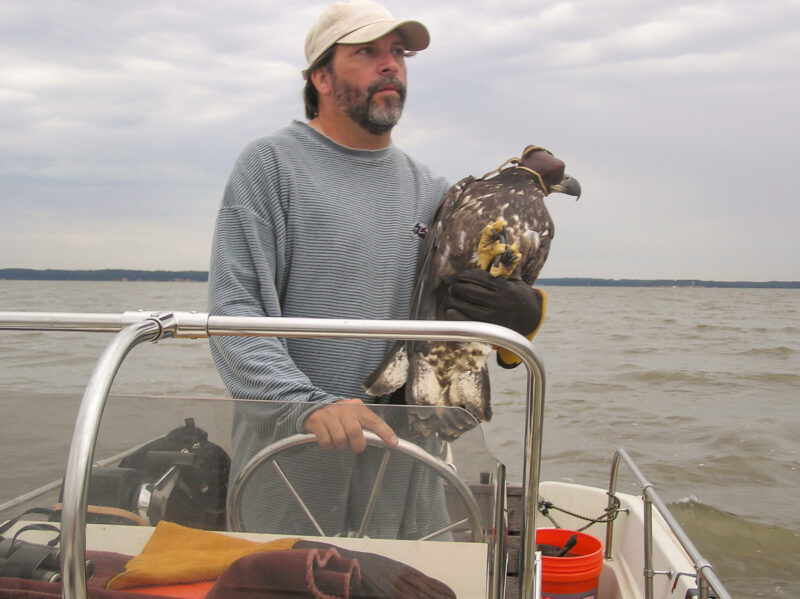
Bryan Watts pilots boat over to Taylor Island with young eagle in hand. Photo by Libby Mojica.
We meet at 4AM and begin loading a checklist of gear onto the boat – banding box, leaders, floats, bungees, anchor weights and a cooler full of prepared catfish. We will be using floating fish sets to take advantage of the light winds. Given the clear forecast, we know that the birds will be perch hunting in the early morning, but as the heat of the day builds they will leave the trees and rise with thermals to hunt from high above. We will follow. Trapping is a dance with eagles in the lead and us anticipating and reacting to their movements.
The floating fish trap uses a fish to entice eagles down to a noose array. The trap includes a floating fish and two to four monofilament nooses that are rigged through the fish to a drag line connected to a weight with a bungee cord. As the eagle attempts to pluck the fish from the water surface, the tension closes the nooses around the foot or toe and the bungee cord eases the bird down onto the water where it is retrieved by boat. If the eagle is able to avoid the nooses, the monofilament pulls through the fish and the eagle steals a fresh meal. This cat and mouse game plays on until an eagle is caught or we run out of fish. Eagles are very wary and the key to bringing them down and enticing them to strike is providing a fish that floats naturally. To boost our merchandise, we make an incision in the side, insert Styrofoam and suture the incision. Styrofoam placed in the right positions allows us to float the fish on its back. We use catfish and the white belly contrasting with the water is irresistible to a hungry eagle. The key to a successful catch is to rig the nooses so that the eagle cannot avoid them when picking up the fish. The trap is most effective on flat water. High winds or currents will pull the fish on its tether and close the nooses prematurely.
I am trapping today with Libby “Magic Hands” Mojica. Libby learned the craft of harness design and fitting eagles for transmitter deployment while working on her master’s project at the University of Georgia. Her project evaluated migration routes of Florida eagles and was part of a tracking study led by Brian Millsap contrasting the ecology of eagles nesting in urban and rural landscapes. Libby is an industrious field researcher who is well organized and understands the pitfalls and blind alleyways of putting projects on the ground. She had spent half the night rigging and floating catfish in the hotel bathtub to make sure that they sat naturally and would attract discerning eagles that demand quality. By the time we loaded the boat, she had several catfish rigged in individual containers stacked in a cooler.
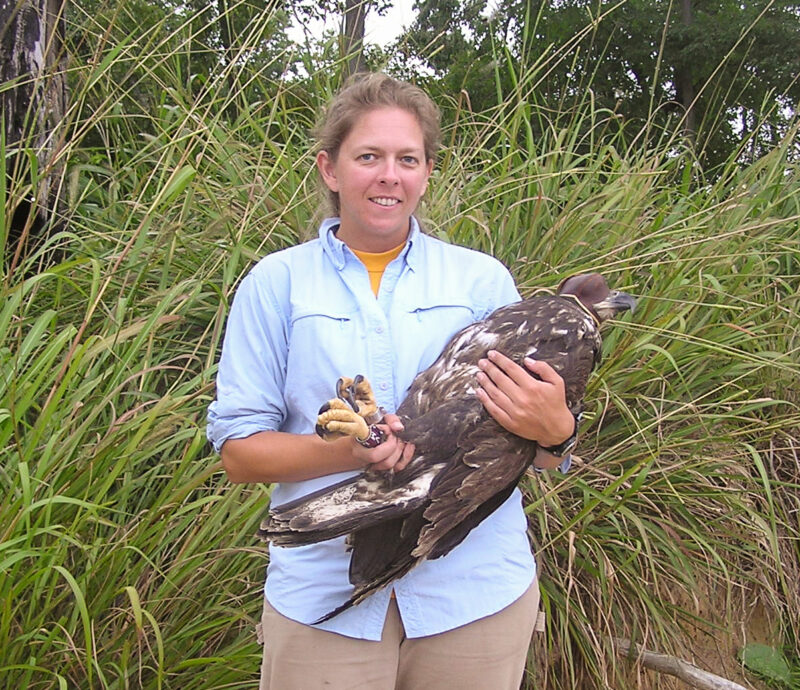
Libby Mojica with young eagle on the shoreline of Taylor Island in the heart of Aberdeen Proving Ground. Photo by Bryan Watts.
The stars are out in force, and the water is like glass as Libby throws the bow line. As we nudge out into the river and away from the harbor lights, we enter complete blackness, like turning off a headlamp in a cave. We are working before the age of GPS. I turn the boat to the east to find a distant but familiar light marker north of Dove’s Cove. I push the throttle until the boat pushes over the bow wave and we plane out onto smooth water. The sensation of moving on still water into blackness is sublime and for a short period time collapses like floating weightless into deep space. When we pass Dove Cove, the light the black outline of Briery Point appears and I throttle back and the boat slumps to a stop. We will work here to rig sets and wait for the predawn light.
The trapping day begins just as the light allows us to make our way over to Tower Cove. The shoreline is still murky, and we cannot see eagles in the trees, but we know they are there and watching. We turn west along the shoreline and begin to drop sets on the port side away from prying eyes. The sets are rigged with eight feet of leader so that we can drop them on the fly in less than six feet of water. In addition to the fish, we have attached a red float on a separate leader linked to the weight so that we can locate the traps from a distance and monitor their status. We deploy three traps within eighty meters of the shoreline and move upstream to take up an observation position. Within twenty minutes the morning chorus begins with eagles cackling and replying like echoes in the dark. A quick scan reveals two adults, a third-year bird and two hatch-year birds perched in hardwoods along the water. We are excited by the assemblage.
We played the game with these eagles for more than an hour. The third-year bird was turned at an angle to the water, giving the closest catfish the side eye like a dog told to leave his treat. This went on for an admirable period until the bird flew out and hit the fish, picking it up and flying until it reached the end of the leader before dropping it and exiting the cove to the east. One of the adults flew down to the nearest fish, stole it and flew back up to the same perch to eat it in sight of the boat. We watched in disgust as it skillfully pitched pieces of Styrofoam. One of the two hatch-year birds flew out to the far fish and circled low six times. Not to be left out, the second hatch-year bird followed and hit the fish getting caught and pulled down to the water. The bird rose off the water three times before we could reach it and escaped leaving the floating fish. Defeated in round one, we picked up the traps and moved down the shoreline.
We worked west along the north shoreline for another two hours. We set one fish in Redman Cove, where a second-year and an adult bird were perched looking out over the water. The birds watched us set the fish and then ignored it for more than forty minutes until we retrieved it. We moved west down to Chillbury Point where three adults were perched in different oak trees. We set two fish and watched as all three birds flew out to inspect the fish. The birds circled over fish a combined fifteen times and all returned to the shoreline to signal that the fish didn’t pass the smell test and the game was over. By 10AM, the scorecard read trappers zero and fifteen eagles flying free including five eagles that shunned the fish, seven eagles that inspected fish but made no contact, one bird that hit and dropped a fish, one bird that stole a fish and one bird that was caught briefly but escaped. After the embarrassing showing at Chillbury, we needed to reshuffle the deck and moved down to the mouth of Sod Run to sit and wait for birds to begin leaving their morning perches.
Just after 11AM we began to see birds flying overhead and streaming downriver. Unlike the intimate shoreline trapping, soaring birds are able to scan the entire surface of the water and we want placement that gives the fish maximum visibility. We moved downriver to the mouth of Lauderick Creek to take advantage of the movement, set a fish one hundred meters out and retreated to a watch site along the shoreline. Within five minutes, an adult halted its forward movement and began to descend from over five hundred feet. The bird spiraled down and flew tight circles to bleed off speed and made a shallow stoop at the fish getting caught and being pulled back down to the water. We quickly retrieved the bird, placed a hood over its head and moved over to the shoreline for processing.
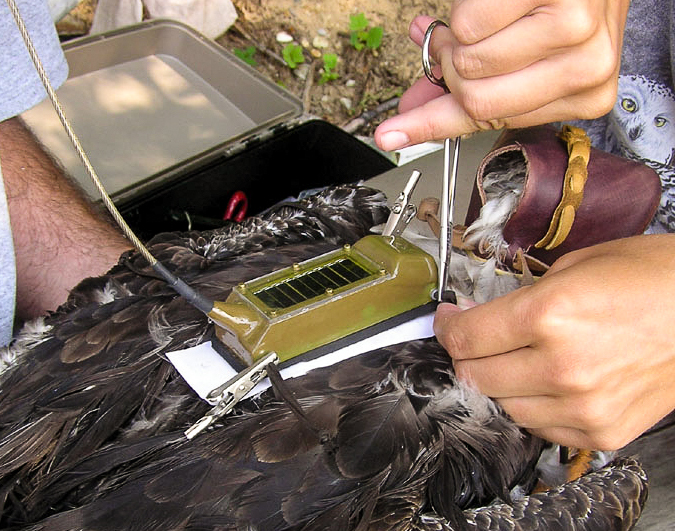
Libby “Magic Hands” Mojica works on transmitter fit and finish for the adult female caught in the mouth of Lauderick Creek. This bird was a local breeder on Aberdeen Proving Ground. CCB photo.
The adult bird was a handful. The large fleshy feet gave the bird away as a female and a weight of 4,550 grams clinched it. We measured and banded the bird and examined her plumage. The plumage pattern indicated that she was a full adult of unknown age. She had fresh eighth and ninth primaries that were three quarters full length. Chesapeake Bay adults initiate a partial flight-feather molt in April or May just as their nestlings hatch. Florida adults, the other population using the Bay in August, have a much earlier breeding season and would have completed their partial molt, suggesting that this bird was a local breeder. We fitted her with a transmitter, closed out the processing and released the bird from the bow of the boat. Tracking data over the next week would confirm that the bird was from a nest on Fairview Point within site of where we had trapped her.
August 19th – Today we will use padded leg-hold traps with a large catfish on a sandbar around the mouth of Romney creek, just up the Bay shoreline from the Bush River. We had been waiting for two weeks until low tide coincided with dawn. We place the fish on a bar that is only exposed during low tide. The upper reaches of Romney support the largest communal roost of eagles on Aberdeen, often exceeding one hundred individuals. As the eagles break from the roost at dawn they follow Romney Creek to its mouth, searching for whatever treasures the high waters have left during the night.
Our trapping scene is a large ten-pound catfish that has washed up on the bar. Because of its size, the set will bring eagles down to feed on the ground. The fish will be secured to a weight buried in the sand by a leader so that eagles will not be able to drag it off. Placed around the fish will be three leg-hold traps also tethered to the weight with bungee cords, all buried except for the trigger pans. Eagles will land on the ground to feed and be caught by the traps. We will be using padded #2 double-spring leg-holds with one of the springs removed. These traps do not snap hard and can be closed on your finger without any concern. Their main function is to hold birds for brief periods.
Because of the logistics and set up time we meet at 3:30AM and load gear onto the boat. It is overcast and spitting rain with a low ceiling. We move out and when we leave the mouth of the Bush River I can barely make out the light buoy off Cherry Tree Point. We turn north and make our way on a south wind with the boat rising and falling blindly into the troughs. The spray is surprisingly warm on our faces. When we see the outline of Locust Point, a high bluff guarding the creek, we turn into the creek mouth. We know the water will be thin, so we turn on our headlamps and creep over to the bar. We dig out a sandpit, place the anchor weight and make the set. We use a broom to brush the tracks away to leave a clean scene. The fish looks fresh and enticing. We heard no eagles calling during our setup and hope that we have slipped in and out undetected. We creep across the mouth of the creek over to Taylor Island and back the boat, up into a large patch of common read to hide and wait for dawn.
The light is muted and as dawn approaches, we strain to see the sandbar. No birds are calling but we glimpse what appears to be eagle activity around the sandbar. We pull out of the hide and see three eagles on the ground fighting over the fish. As we approach, two birds fly off, leaving a hatch-year bird trapped on the beach. We extract the bird, pull the traps and move over to Taylor Island to sit on an ancient log to work. After measuring, weighing and banding the bird we work on fitting the transmitter. The harness is made of Teflon ribbon. Unlike stretchy material used in some harnesses, Teflon has no give and so precise fit is critical. Magic Hands Mojica works through the stages of fitting and testing the harness and then begins the finishing work. The fit must be set with rivets, and the finishing work includes using superglue to bind the ends of the Teflon to prevent it from unraveling.
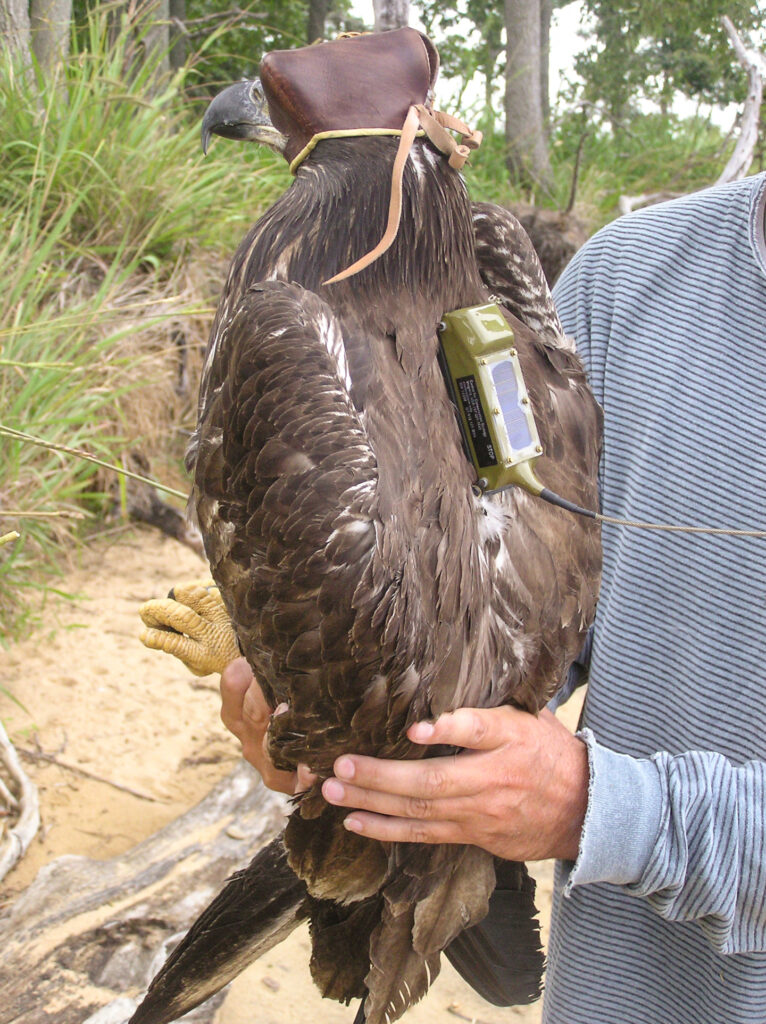
Young eagle caught on sandbar at the mouth of Romney Creek with final transmitter fit and ready for release. Photo by Libby Mojica.
Once we are happy with the fit and finish, I stand up to take the young eagle over to the water for release. As I look down on the ground, I see a white clay pipe mixed in with the gravel along the shoreline. Based on the size and shape of the bowl, the pipe was of an English maker from the 1600s. We had been out trapping and watching and living with eagles for months. Just the sight of the pipe made me immediately identify with a person who sat along this shoreline and looked out over the Bay more than three hundred years ago. What did this person see when he looked out on the water of the Bay? Did he sit on the shoreline and watch eagles fishing, tail chasing and going about their daily lives? What did he feel about the Bay – about eagles?
Most of us have no physical connection to the land of our ancestors. We cannot even identify the land that our great grandparents walked over and worked on every day. Most likely, the land that they had such intimate knowledge of has been paved over with rows of condominiums replacing fields of corn. But the power of landscape remains. The water, with its endless moods, the diving osprey, the heron gliding along the tree line and the cackling of eagles breaking the stillness of dawn remain. Eagles do not belong solely to our time but to the many generations that have come before and to the multitude of generations to come. They are part of our sense of place, and watching them brings us closer to our ancestors who also reveled in their beauty and majesty. Like an October sunset after a hard day’s work, they are part of our natural heritage. Unlike so many luxuries reserved for the privileged few, eagles belong to all of us regardless of wealth or status. More importantly, the eagles belong to themselves.