Impact of avian flu on coastal peregrines continues
July 14, 2026
Findings of 2024 osprey work throughout the Chesapeake Bay published
July 14, 2026By: Chance Hines
7/8/2026
Every autumn at about this time of year, a trickle of whimbrel begin descending into marshes and mudflats on the Eastern Shore of Virginia. Over the next few weeks that trickle will become a flood of tens of thousands. Once here, they eat their fill of fiddler crabs as they prepare for southward trans-oceanic flights. Prior to the 21st century, the origin and migratory paths for these birds was murky but advances in tracking technology have provided opportunities for researchers to follow these birds throughout the year.
The Center for Conservation Biology (CCB) has studied this species for decades and, through early tracking efforts, described the annual cycle for two distinct populations that move through Atlantic Coast. One population nests in the Mackenzie Delta region along the northern coast of Alaska and Canada while the other nests near the Hudson Bay. The latter population that nests near Hudson Bay seems to almost exclusively depend on the Eastern Shore during autumn, making this area especially important for them. Those early tracking efforts provided the foundation for understanding the Whimbrel life cycle, but each tracking effort reveals new insights.
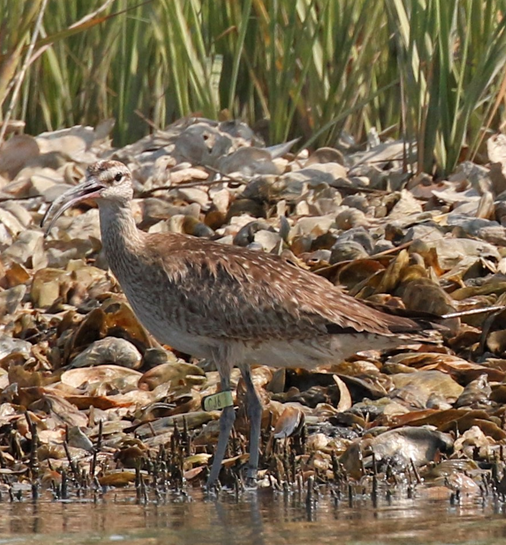
A whimbrel loafs along the edges of a shell rake during high tide at Virginia’s Eastern Shore. Photograph by Mario Balitbit.
Our most recent efforts continue to refine our understanding of these birds’ biology and distribution. One of these insights may redefine the limits of the Hudson Bay population. Most individuals we have been aware of have primarily bred along and near the Hudson Bay shoreline, but it appears that a substantial number of birds may breed in barren grounds between the Hudson Bay and the Great Slave Lake.
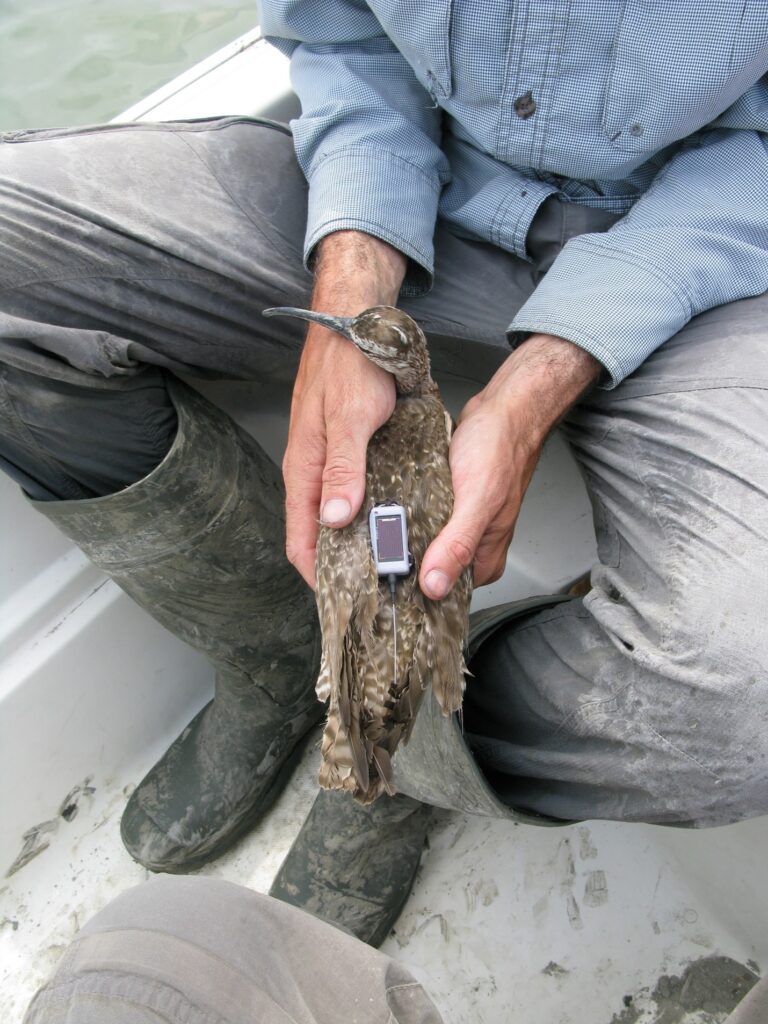
CCB Biologist Chance Hines holds a whimbrel captured on the Eastern Shore of Virginia that was fitted with a transmitter. These transmitters use a solar cell to recharge their battery to increase the longevity of the transmitters. Photograph by Bryan Watts.
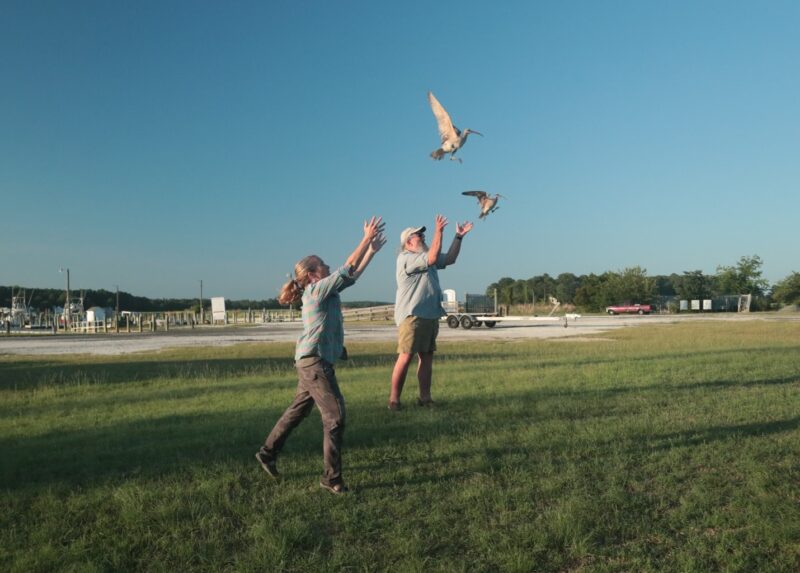
Alex Wilke and Barry Truitt (both TNC) release whimbrels after tagging at Willis Wharf, VA. Photograph by Bryan Watts.
The Canadian barren grounds are some of the most isolated areas on earth, and while buried beneath ice and snow during most months, support a rich mosaic of shrublands and wetlands during the summer. Permafrost plays a major role in shaping this landscape by trapping water near the surface, creating the wet habitat that supports a diverse suite of plants and animals. As temperatures rise and the ice thaws, the short summer brings a pulse of arthropods that likely provide an abundant food source for young whimbrels and then berries later in the summer to fuel their journey to the Eastern Shore.
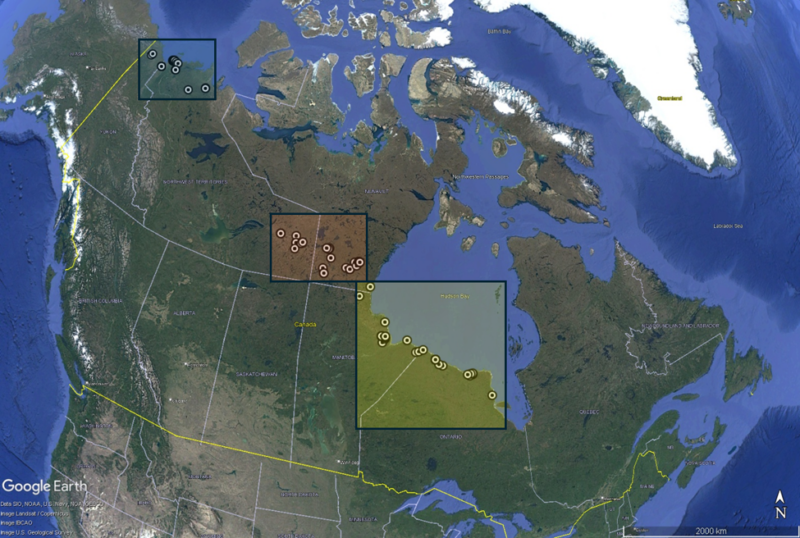
Breeding season centroids for whimbrel that CCB has tracked. Birds in the blue polygon breed in the Mackenzie Delta, birds in the yellow polygon breed along or near the shore of the Hudson Bay, and birds in the orange polygon breed in the Canadian barren grounds. Data from CCB.
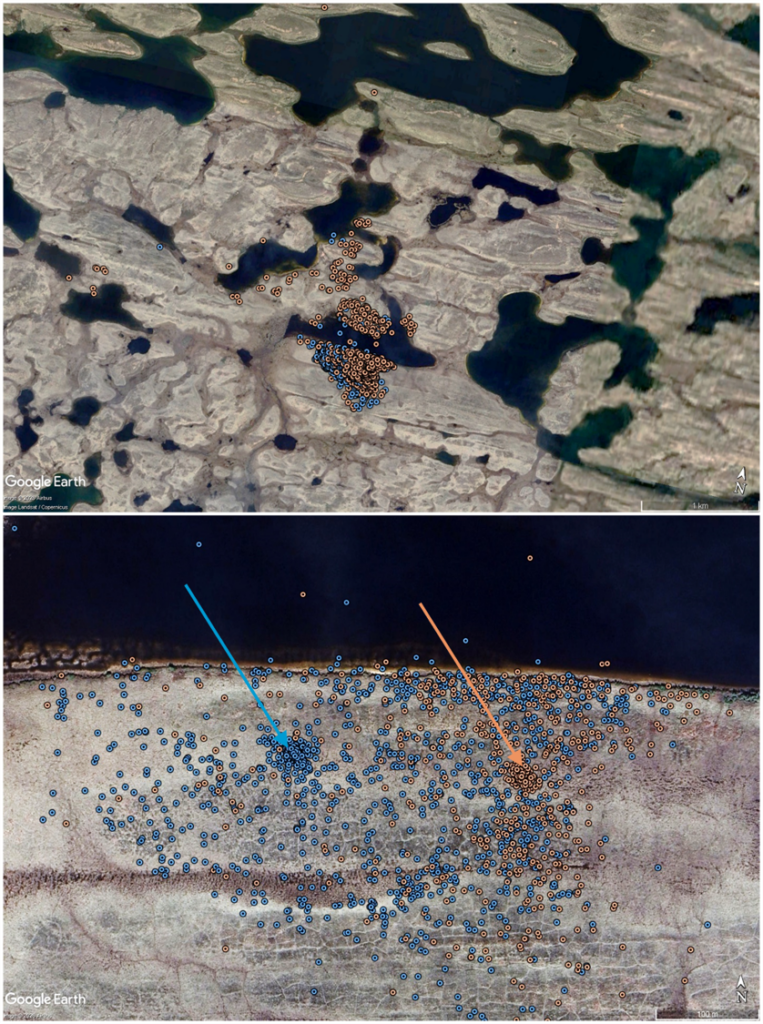
GPS locations from 2024 (orange) and 2025 (blue) breeding seasons for the whimbrel that bred the furthest into the interior of the barren grounds. The top image shows the landscape that primarily includes marsh and small lakes created by glacial processes and the bottom image shows the tightest clusters of points which likely represent nesting locations (see arrows) for each year, less than 200 m from each other. Data from CCB.
Unlike breeding areas nearer Hudson Bay and the Mackenzie Delta, where whimbrels have been the focus of long-term studies, the interior barren grounds remain largely unexplored. CCB’s most recent tracking results suggest that these landscapes may play a larger role in Whimbrel ecology than previously recognized and this role may become increasingly important as warmer and warmer annual temperatures alter habitat at the southern extent of their breeding range.