Uncovering the Origins of Virginia’s Whimbrels
July 14, 2026
Pretty Colors
July 14, 2026By: Bryan Watts
7/9/2026
In recent years we have published papers on the historic decline of osprey breeding performance in Mobjack Bay (a subestuary of the lower Chesapeake) and the role of menhaden in driving the decline. One of these papers entitled “Food Supplementation increases reproductive performance of ospreys in the lower Chesapeake Bay” presented the response of breeding performance to experimental food supplementation. The other paper entitled “Demographic response of osprey within the lower Chesapeake Bay to fluctuations in menhaden stock” presented a retrospective analysis of data spanning 45 years including changes in both breeding performance and the rate of fish deliveries to nests. Both of these studies documented that changes in food stress were driving changes in reproductive performance. The central concern outlined in these papers is that reproductive rates are no longer adequate to support a stable population. One of the criticisms of these works from industry, regulatory agencies and some academics is that “Mobjack Bay only reflects conditions within a small area of the larger Bay” and is not representative of the larger Bay. That the results from Mobjack Bay were one-offs.
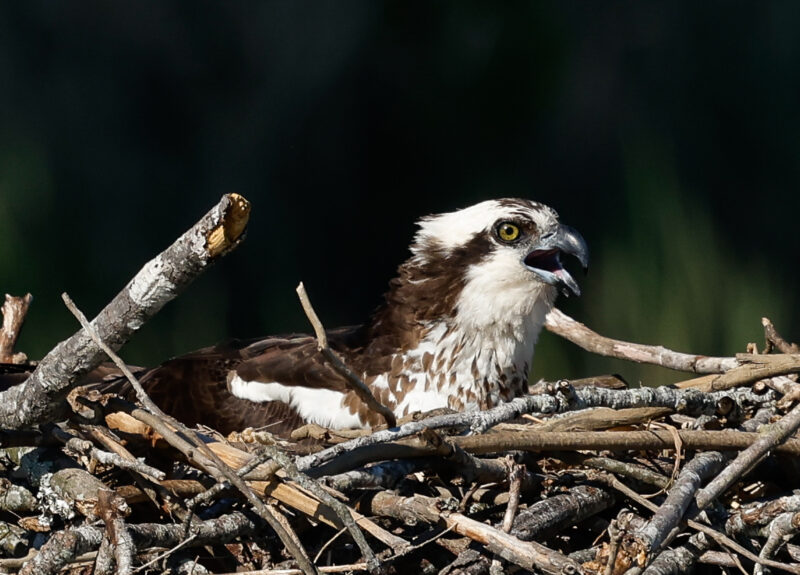
Female osprey incubates a clutch on the Rappahannock River. Only one third of pairs within high salinity waters successfully raised broods in 2024 compared to two thirds of pairs in low salinity waters. Photo by Bryan Watts.
In response to these comments, CCB along with other partners expanded data collection to 12 study areas throughout the Chesapeake Bay, including 10 study areas within waters above 10 parts per thousand salinity where osprey are believed to be menhaden-dependent and two study areas within low-salinity waters where osprey have been shown not to utilize menhaden. Within these study areas we monitored 571 osprey pairs to examine productivity. Results of this effort have recently been published in a paper entitled “Widespread reproductive deficits in Chesapeake Bay ospreys” that appeared in the journal Frontiers in Marine Science.
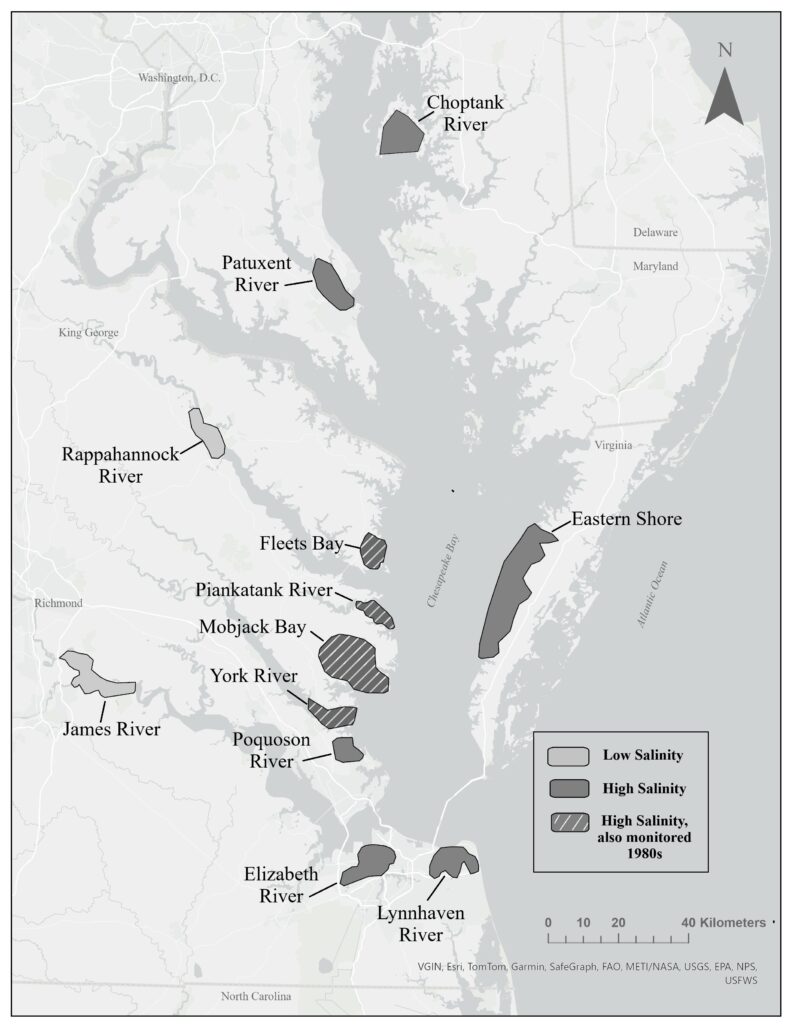
Map of the Chesapeake Bay study area including high salinity study areas monitored in 2024 and during the 1980s, and low salinity study areas monitored in 2024. Each study area included 30-80 pairs of ospreys that were monitored to determine breeding performance. Data from CCB.
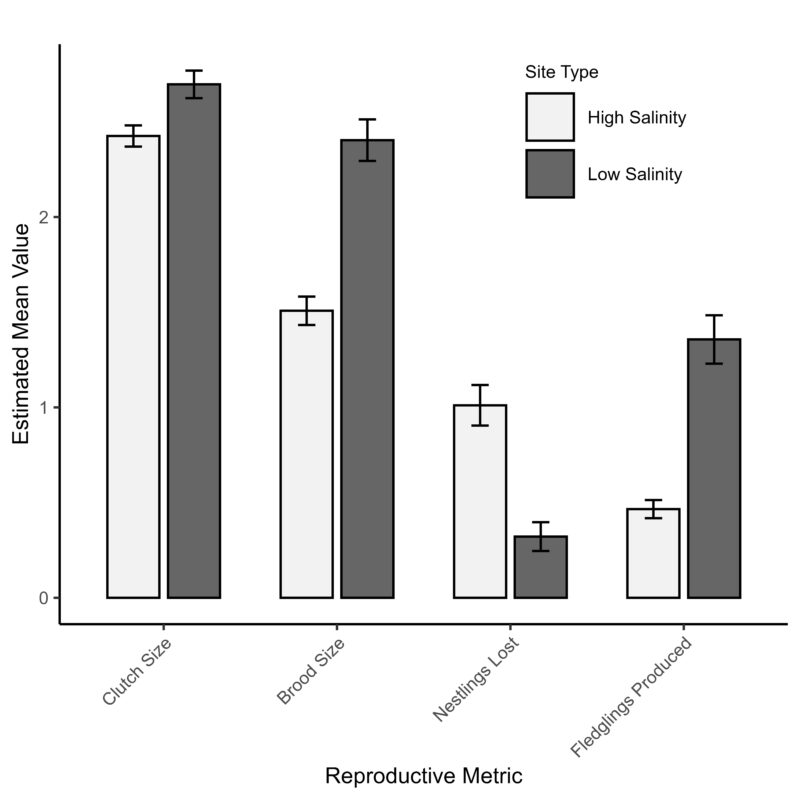
Results of breeding performance for ospreys within high and low salinity waters during the 2024 breeding season. Data from CCB.
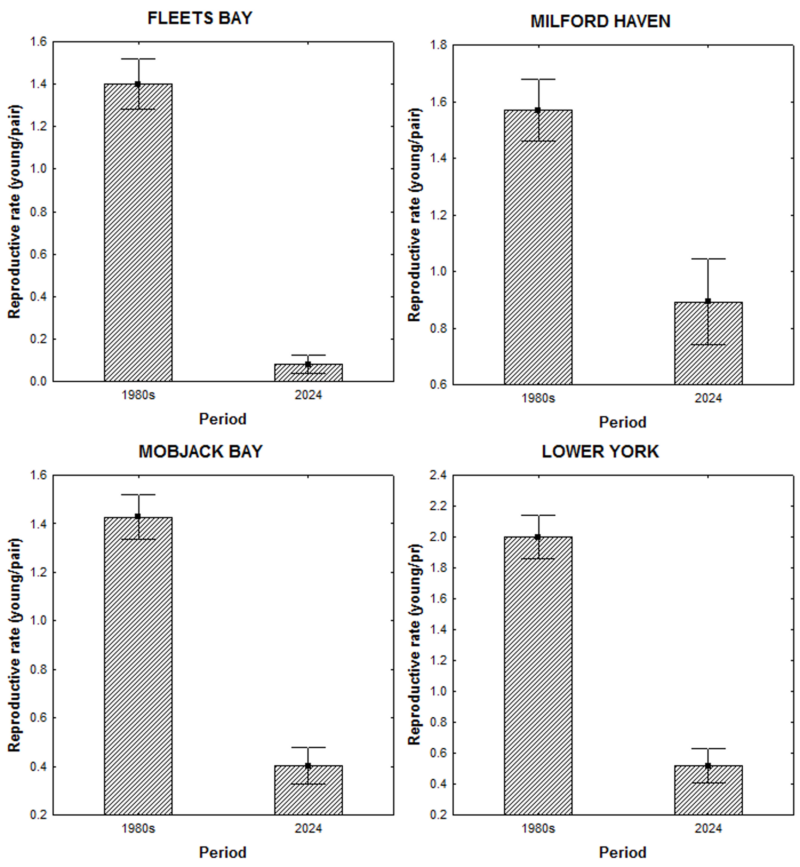
Comparisons of osprey productivity between 2024 and the 1980s for four study areas within high-salinity water. Productivity was significantly higher during the 1980s than in 2024. Data from CCB.
Results from 2024 confirm that earlier results reported for Mobjack Bay were not “one-offs” as claimed, but represent what is happening throughout the main stem of the Chesapeake Bay. Results show that the likelihood that pairs reached productivity levels required for population maintenance was associated with salinity. All high salinity study areas were classified as demographic sinks (produced fewer young than required for population maintenance) whereas low salinity areas were demographic sources (produced more young than required for population maintenance). Breeding metrics including proportion of pairs breeding, clutch size, proportion of pairs failing, incidence of brood reduction and mean number of nestlings lost suggest that high and low salinity areas differ in their level of food stress (inadequate nutrition due to food scarcity or low quality). Four of the study areas monitored in 2024 were compared back to the 1980s using data collected by Mitchell Byrd. Temporal comparisons document a significant shift in demographic status and metrics of food stress. Productivity was significantly higher and brood reduction was significantly lower for all four sites during the 1980s compared to 2024. High salinity sites during the 1980s were comparable to low salinity sites in 2024. Although several factors are operating within Chesapeake Bay that may adversely affect productivity, we suggest that low Atlantic menhaden (Brevoortia tyrannus) availability as a food source is a major driver of poor reproduction within high salinity waters.
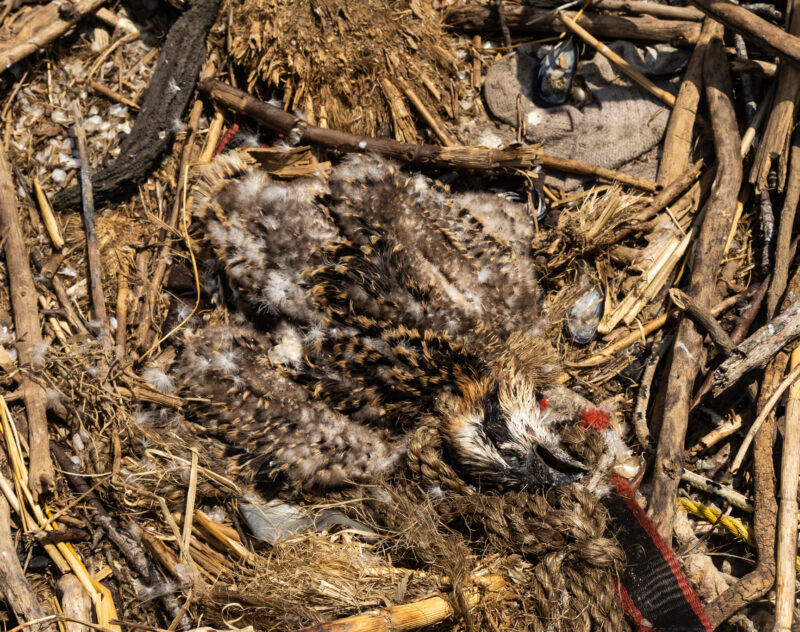
Dead nestling on the Elizabeth River. Loss of chicks due to starvation was the primary cause of low productivity in high-salinity waters and was the difference between selected areas compared to the 1980s. Photo by Bryan Watts.
CCB and partners have continued to work during the 2025 and 2026 breeding seasons to better understand the implications of recent patterns in productivity on the stability of the Bay-wide osprey population.