
Pretty Colors
July 14, 2026
Osprey starvation reaches northern mid-Atlantic and southern New England
September 22, 2026News Advisory
FROM: The Center for Conservation Biology, William & Mary
FOR IMMEDIATE RELEASE: 14 September 2026
MEDIA CONTACTS:
Dr. Bryan D. Watts, Director
The Center for Conservation Biology
William & Mary
bdwatt@wm.edu
(757) 221-2247
2026 osprey breeding performance was the worst ever recorded for the Chesapeake Bay
BRIEF
(Williamsburg, VA)— The Center for Conservation Biology at William & Mary has compiled the 2026 breeding performance results for osprey in the Chesapeake Bay. The monitoring effort included 937 osprey pairs distributed among twenty-three study areas. Study areas were distributed across the salinity gradient, from tidal-fresh waters near the fall line to ocean-strength waters around the mouth of the Bay. The primary objectives for the 2026 nesting season were to assess reproductive rates and evaluate the stability of the Bay-wide osprey population based on patterns observed. Breeding pairs were monitored throughout the nesting season (March-August) to determine nesting success and productivity.
The 2026 breeding season was the worst productivity year ever recorded for osprey in the Chesapeake Bay. Average productivity in waters above 5 parts per thousand (ppt) salinity (N = 769) was 0.25 young/pair. On a global scale, the annual breeding performance required to maintain a stable population ranges from 0.8 to 1.3 young/pair. Only pairs nesting within tidal fresh waters (N = 168 nests producing 1.04 young/pair) exceeded the breeding performance threshold required for population maintenance. Eighty-one percent of all pairs nesting in waters above 5 ppt failed to fledge any young. Of pairs that did produce young, 70% were single-chick broods. The 2026 results extend the ongoing trend of productivity decline throughout saltier regions of the Bay. Productivity in the Chesapeake has dropped in recent years from 0.51 in 2024 to 0.35 in 2025 to 0.25 in 2026. Estimates of reproductive deficits should be considered conservative. We have only monitored the survival of young to fledging and there is increasing evidence that post-fledging survival may be low.
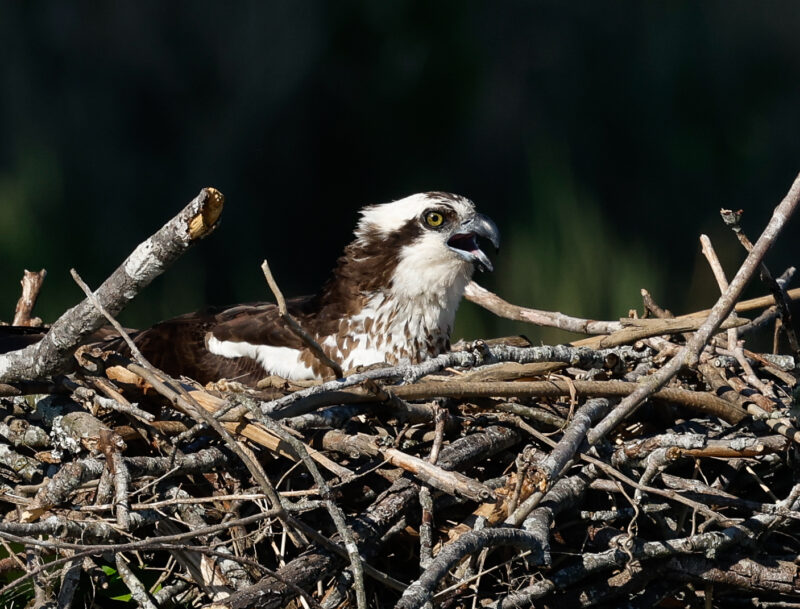
Female osprey incubating within the upper James River study area. Pairs within tidal fresh waters of the Chesapeake Bay continue to produce above maintenance levels. Photo by Bryan Watts.
Implications for the Population
The Chesapeake Bay supports the largest osprey breeding population in the world and has been considered for many decades to be a global stronghold for the species. Given the poor reproductive rates recorded in recent years, this population is not sustainable. Current reproductive rates are less than 50% of those recorded during the height of the DDT pesticide crisis. Based on the current demographics, we would expect the breeding population to decline at an average rate of 14%/year. This annual loss rate is dramatic and without a change in course would be expected to result in a 50% decline in the population over the next decade. However, rates of decline are expected to vary geographically within the Chesapeake. Noticeable declines in the number of occupied territories are ongoing within several study areas.
The Chesapeake Bay osprey population will not be rescued by pairs nesting within the tidal-fresh reaches of the Bay that continue to produce above maintenance levels. If we consider the minimum production threshold for stability (i.e., 0.8 young/pair), the 2026 results suggest that in order for the Bay-wide population to be stable we would need ~2.75 pairs in the area of surplus (tidal-fresh waters) for every pair in the area of deficit (>5 ppt waters). During the last systematic survey of the Chesapeake Bay osprey population (1995-1996) there were 7.5 pairs within the area of deficit for every one pair in the area of surplus.
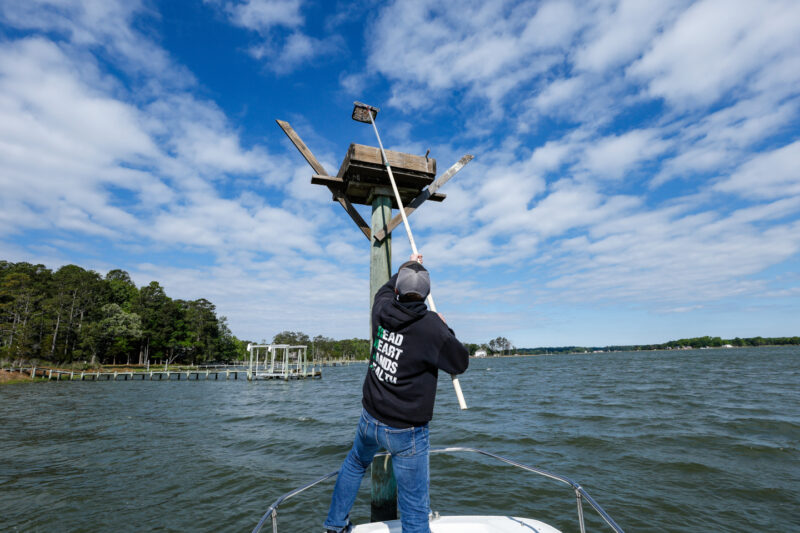
Liam Beheler checks osprey nest with a mirror pole on the lower York River. CCB and partners conducted thousands of nest checks during the 2026 breeding season to estimate reproductive rates throughout the Chesapeake Bay. Photo by Bryan Watts.
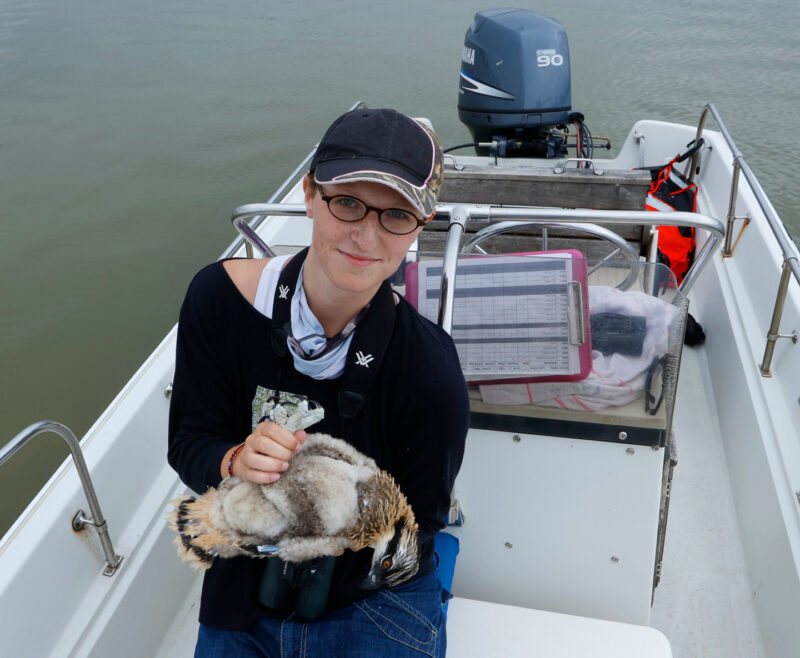
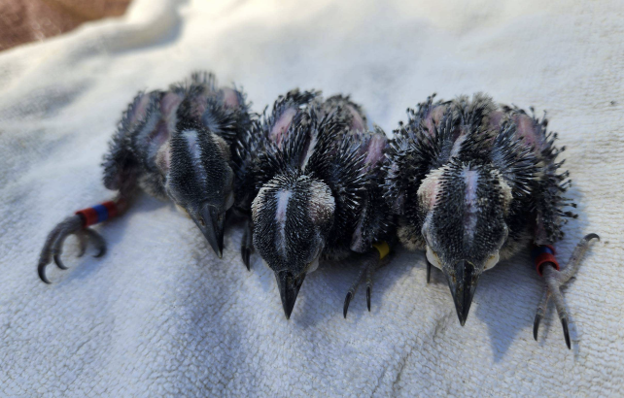
William & Mary undergraduate intern Lucia Hughes with young osprey on the Rappahannock River. Students have played an important part in both monitoring osprey productivity and managing monitoring data over the past several years. Photo by Bryan Watts.
Causes of Nesting Failures
Many factors may cause nest failures in Chesapeake osprey including storms, predation, human disturbance and heat stress. The contribution of individual factors to nest losses varies from year to year. Many of these factors have recognizable signatures in the field that do not match current observations. In 2026, as in the past several years, the factor driving widespread nesting failure was food stress. A constellation of quantified metrics of food stress including high rates of females not laying clutches, low provisioning rates, emaciated chicks with stunted development, asymmetric broods, sequential brood reduction, shifts in mean brood size, pairs abandoning viable clutches or broods, pairs abandoning breeding areas en masse and high failure rates support this conclusion. Beyond these quantified metrics, we are observing young starve in nests.
The extreme food stress documented in recent years appears to be caused by changes in the availability of Atlantic menhaden to nesting ospreys in the Chesapeake Bay. For decades, menhaden have been considered to be a keystone prey species for the osprey population due to their high abundance, high energy density and schooling behavior. In some parts of the Chesapeake, the rate of delivery of menhaden to nests has declined by more than 80% since the 1980s. The shift in diet away from menhaden has resulted in a 50% decline in the energy content of osprey diets. The combination of a reduced rate of menhaden delivery to nests and lower energy content of the diet has resulted in an increased rate of nest failure and reduced mean brood size. The underlying causes of reduced availability of menhaden to osprey are not clear. Climate change, commercial harvest, changes in distribution or delayed entry into Bay waters may be contributing factors. Ospreys require high fish abundance during April, May and June to successfully raise broods. Ospreys are unable to successfully adjust their breeding chronology when large numbers of menhaden do not arrive until late June or July.
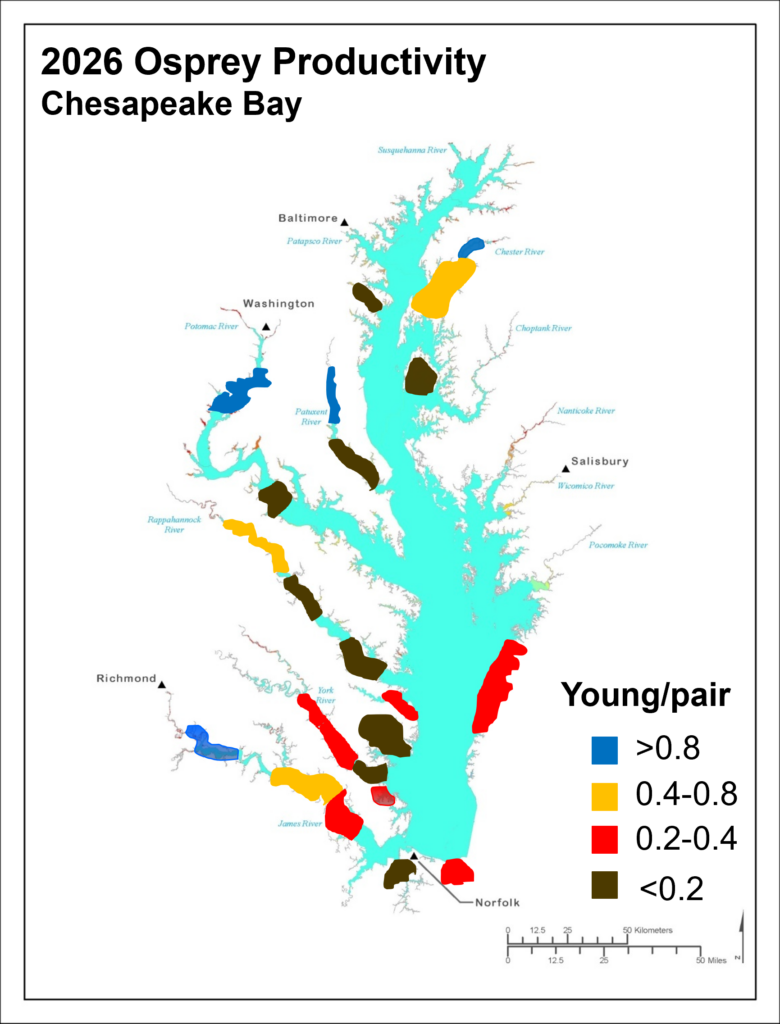
Results of 2026 osprey productivity monitoring throughout the Chesapeake Bay. The systematic monitoring effort included 973 osprey pairs within 23 study areas positioned across the salinity gradient. None of the study areas within waters above 5 ppt salinity reached productivity thresholds for population maintenance. All of the study areas within tidal fresh waters exceeded required productivity thresholds. Data from CCB.
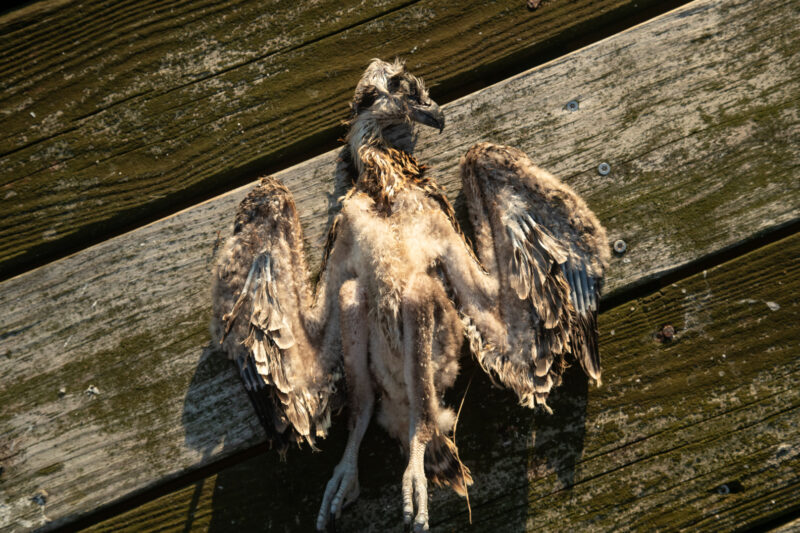
An emaciated osprey chick that starved on Mobjack Bay. Several recorded metrics as well as starved chicks indicate that the low productivity recorded in 2026 was driven by food stress. Photo by Bryan Watts.
ADDITIONAL DETAILS
2025-2026 Objectives
In recent years we have published papers on the historic decline of osprey breeding performance in Mobjack Bay (a subestuary of the lower Chesapeake) and the role of menhaden in driving the decline. One of the criticisms of this early work is that “Mobjack Bay only reflects conditions within a small area of the larger Bay” and is not representative of the entire Bay. In 2024, we collected reproductive data in ten study areas throughout the main stem (>10 ppt) of the Bay where ospreys are believed to be menhaden-dependent and two study areas within low salinity (<5ppt) reference sites where osprey depend on catfish and gizzard shad. Results from 2024 were published in Frontiers in Marine Science during the spring of 2026. This work showed that findings in Mobjack Bay are not an anomaly as ospreys throughout the main stem of the Bay are suffering unsustainable production most likely due to food stress. The 2024 season also showed that pairs within low-salinity areas were producing above maintenance levels.
The objective of fieldwork in 2025-2026 was to evaluate whether or not the low reproductive rate in the main stem (>10 ppt) of the Bay represents a risk to the broader Bay-wide osprey breeding population. To evaluate the metapopulation dynamics we needed to understand the relative magnitudes of reproductive deficits and surpluses across subpopulations.
Study Areas
The study area included the tidal reach of the Chesapeake Bay from the fall line (landward extent of tidal influence) to the Atlantic Ocean. The study area was subdivided into salinity zones to ensure adequate coverage of conditions. Salinity zones included low salinity (0–4.9 ppt), low mesohaline (5.0-11.9 ppt), high mesohaline (12.0–17.9 ppt) and polyhaline (18.0–30.0 ppt). Specific study areas by salinity zone include low salinity – Upper Chester River, Upper Patuxent River, Upper Potomac River and Upper James River, low mesohaline – Lower Chester River, Severn River, Upper Rappahannock River, Lower Patuxent River, Colonial Beach, Middle Rappahannock River, Middle York River, and Middle James River, high mesohaline – Choptank River Vicinity, Lower Rappahannock River, Piankatank River, Lower York River, Lower James River and Elizabeth River, polyhaline – Bayside Eastern Shore, Mobjack Bay, Lower York River, Poquoson River and Lynnhaven River.
Data Contributors
The Center for Conservation Biology, William & Mary
Eastern Ecological Science Center, U.S. Geological Survey
Virginia Department of Wildlife Resources
Virginia Aquarium & Marine Science Center
Maryland-National Capital Park
Eco-Ed Endeavors
Virginia Osprey Foundation
Operation Osprey
Center for Environment and Society, Washington College