
From Virginia’s Eastern Shore to a Global View of Whimbrel Migration
October 15, 2026By: Chance Hines
9/24/2025
Red-cockaded Woodpeckers (RCWs) at Piney Grove Preserve had another banner year reaching new highs in the number of breeding groups and fledglings produced. Piney Grove has now produced a record number of chicks for the third year in a row and, for the fifth year in a row, at least one new breading group formed.
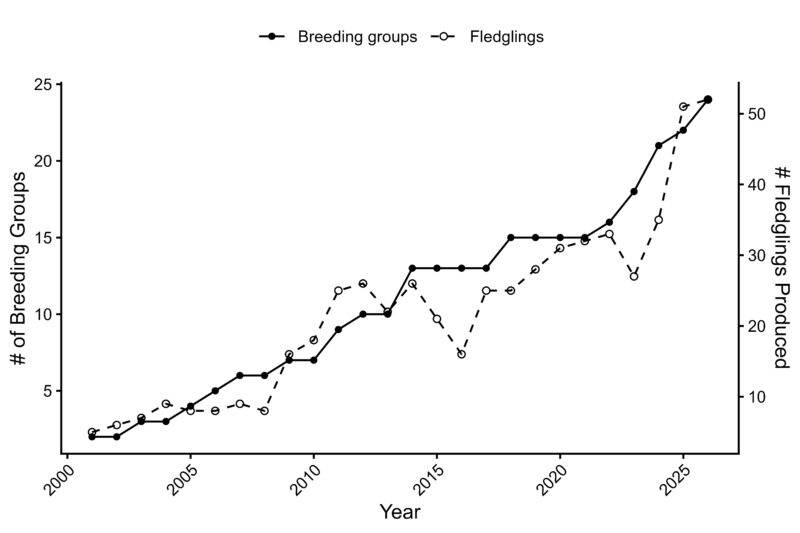
Number of breeding groups and fledglings produced at Piney Grove Preserve between 2002 and 2026. Data from CCB.
This is remarkable considering the population was down to just two breeding groups shortly after the turn of the 21st century. At that time, the Virginia Department of Wildlife Resources (then Virginia Game & Fish Department), The Nature Conservancy, and the Center for Conservation Biology took on the task of saving Virginia’s remaining red-cockaded woodpeckers. The initial goal was to rebuild the population to 10 breeding groups. It took more than a decade to reach that goal, but the population has continued to grow well beyond that number over the past two decades.
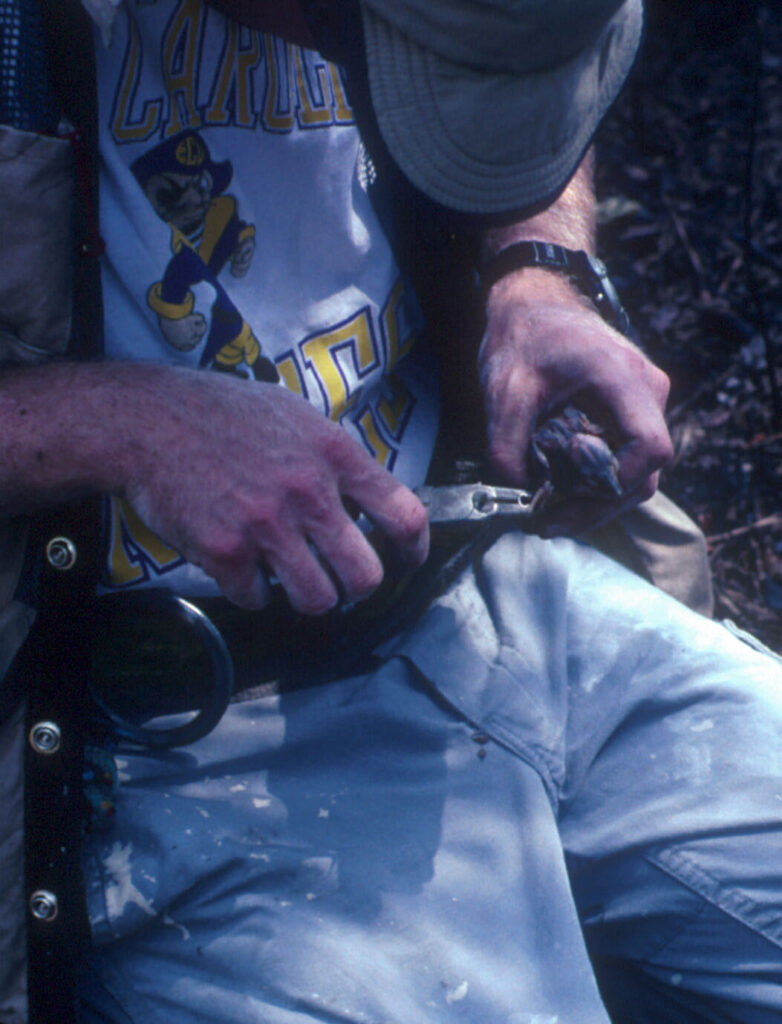
Nestling being banded in 2002. Only two groups nested that year, producing six fledglings. Photo by Bryan Watts.
Partners recognized that, if successful, population growth at Piney Grove would be limited. The Nature Conservancy’s Piney Grove Preserve is approximately 1100 hectares, but research conducted with Virginia RCWs in the 1990s indicated that clusters required about 120 ha each. Planning for the future, DWR purchased adjacent land outside Piney Grove to be managed for red-cockaded woodpeckers and other pine savannah species. Much of this forest was considerably younger than the mature pinewoods at Piney Grove, and the expectation was that it could take decades before red-cockaded woodpeckers began using these areas.
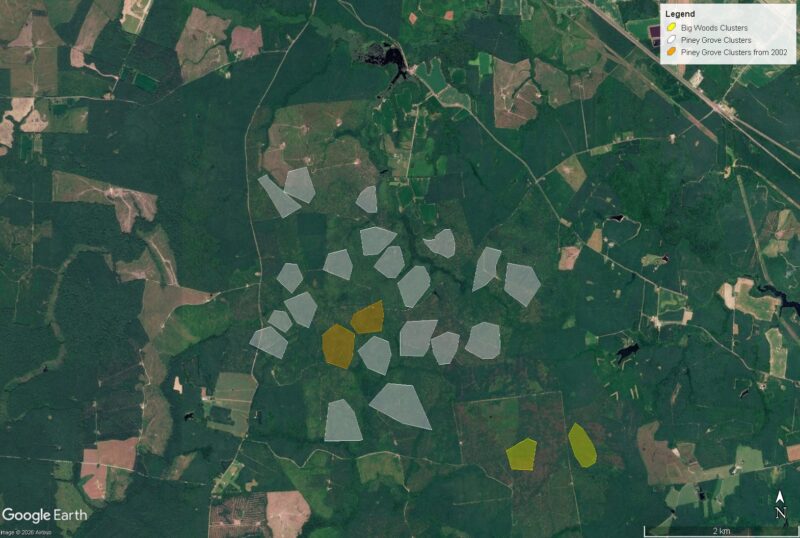
Red-cockaded woodpecker clusters at Piney Grove Preserve (orange/white polygons) and Big Woods WMA (yellow polygons). Data from CCB.
The woodpeckers, however, had other plans and have helped contribute to the population’s growth. In 2018, a red-cockaded woodpecker surprised everyone by excavating a cavity in an isolated mature tree within the middle-aged forest and a female soon joined him to establish a new breeding group outside Piney Grove Preserve. It took a few years for that group to begin producing young, but it has been contributing to population’s growth since 2021. In fact, one of the fledglings produced by that group in 2021 eventually joined one of the two breeding clusters that has persisted since Piney Grove population was at its lowest. That bird is now the breeding male in the cluster.
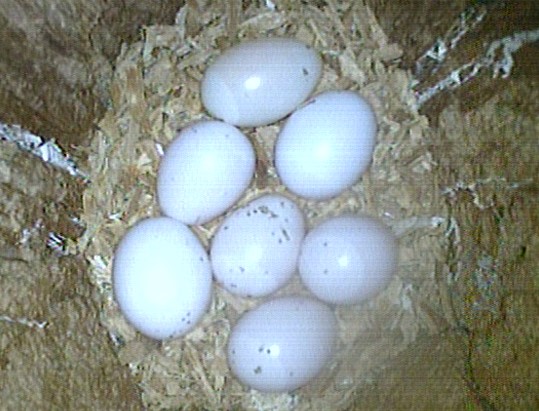
A seven-egg red-cockaded woodpecker clutch at Piney grove Preserve from the 2026 breeding season. Clutches with>4 eggs occasionally occur and are likely a result of two females laying in the same cavity. Photo by Chance Hines.
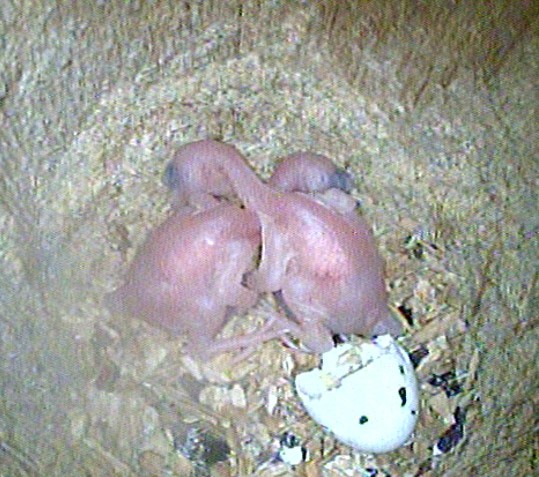
Two recently hatched red-cockaded woodpecker nestlings at Piney Grove Preserve from 2026. After hatching, egg fragments are typically discarded within a couple of days by adults. Photo by Chance Hines.
An additional lone male has been observed roosting in another isolated patch of relatively mature trees in Big Woods (BW) during the past couple winter and spring surveys. This year, he was joined by a female who had hatched from the previous season’s BW cluster. The pair was unsuccessful in their first breeding attempt, which is not unusual for young birds establishing a breeding group for the first time. Still, the attempt is an encouraging sign that another breeding group may be taking shape outside the original Piney Grove population.
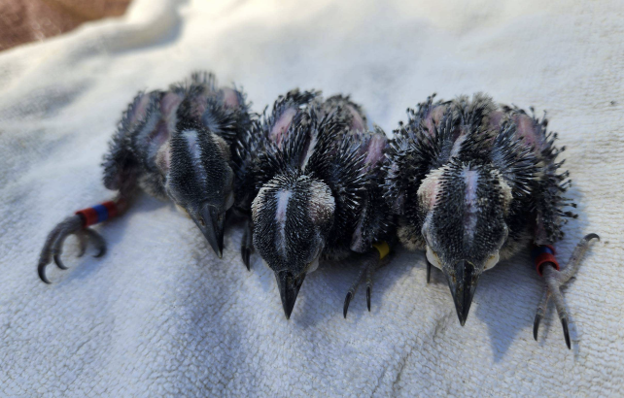
Three nestling red-cockaded woodpeckers banded at Piney Grove Preserve in 2026. These nestlings are close to 10 days old. Photo by Chance Hines.
These new breeding groups are exactly what the partners hoped to see when these projects were initiated in the early 2000s and are the result of their commitment to keeping red-cockaded woodpeckers in Virginia.