Osprey starvation reaches northern mid-Atlantic and southern New England
September 22, 2026
From Virginia’s Eastern Shore to a Global View of Whimbrel Migration
October 15, 2026By: Bryan Watts
10/6/2026
The Chesapeake Bay appears to have always been an important ecological unit for breeding great blue herons. The species was noted as part of the avifauna of the Bay in early colonial times by Hamor (1615) and later by Clayton (1685) and was included in early compiled lists by Thomas Jefferson (1787) and others. In more modern times, numerous colonies were described throughout the Bay during the 1930s through 1950s. Many of these colonies were lost during the 1950s presumably due to the widespread use of DDT. Though our understanding of this deep decline is limited, very few colonies were known to survive into the mid-1960s.
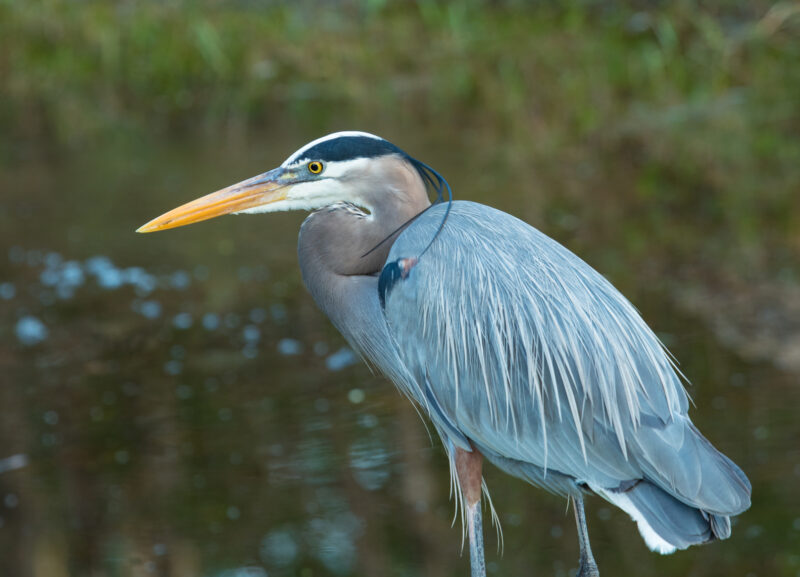
The great blue heron is the largest heron species in North America and the most widespread and abundant colonial waterbird in the Chesapeake Bay. Photo by Bryan Watts.
The first systematic aerial survey of great blue colonies was conducted by Mitchell Byrd as part of the famous Osborn and Custer (1978) survey of heron colonies along the Atlantic Coast. This effort recorded 37 colonies supporting 3,680 pairs in the Bay and represents the first benchmark survey of the population. Several additional benchmark surveys have been conducted over the decades ending with the last effort conducted by Bryan Watts and Bart Paxton in 2013. The latter survey recorded 423 colonies supporting 15,094 breeding pairs. The recovery of the population over time is the focus of a paper recently published in The Journal of Wildlife Management entitled “Recovery of great blue herons (Ardea herodias) within the Chesapeake Bay.”
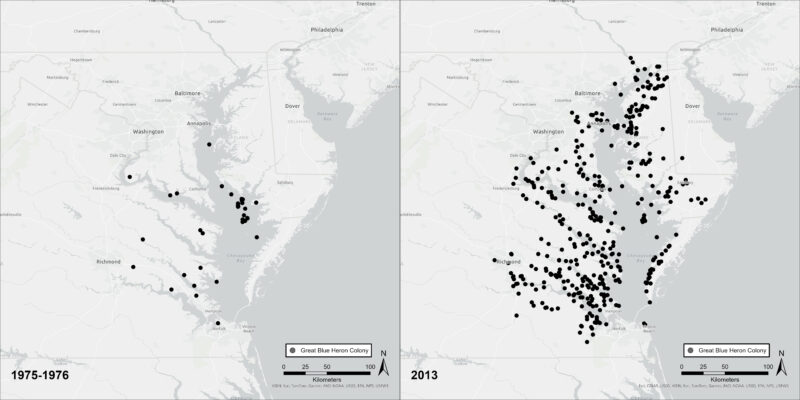
Map of great blue heron colonies within the Chesapeake Bay from the initial benchmark survey in 1975 to the last benchmark survey in 2013.
The paper examines the recovery of the great blue heron breeding population in the Bay, the situations where great blue herons form breeding colonies and changes in colony size over time. Between 1975 and 2013 the breeding population increased with an average doubling time of 18.8 years. The majority of colonies were positioned in supercanopy trees within continuous forests, along forest edges or on isolated islands or marsh hammocks that provide for crown access. The size of colonies declined over the 40-year period with an annual rate of -3.2%. By 2013, less than 4% of all colonies supported more than 100 pairs compared to 34% in 1985. The fragmentation or abandonment of large colonies and establishment of small colonies appears to be a response to the recovery of bald eagles in the Bay. Throughout the 1990s a large portion of large heron colonies were colonized by nesting bald eagles. The largest colony in the Bay at Pooles Island in MD supported 4 eagle nests. By the 2000s many of the larger colonies had begun to splinter into scattered small colonies.
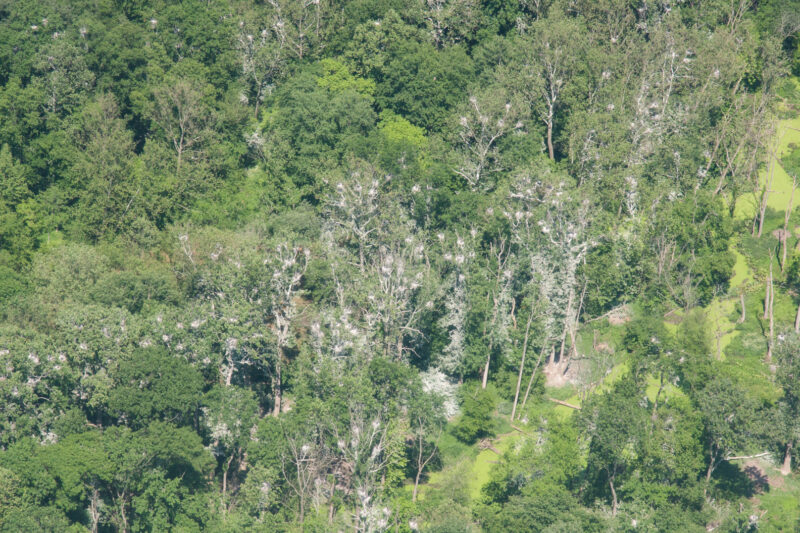
Great blue heron colony in the Chickahominy Swamp. Many colonies are positioned on supercanopy trees, along forest edges or in swamps with scattered trees so that the large birds can fly unobstructed to and from nests. Photo by Bryan Watts.
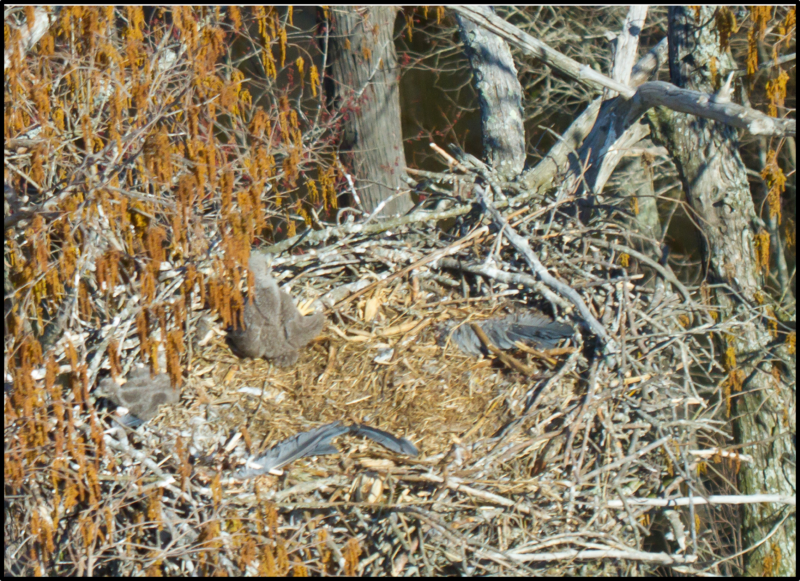
Great blue heron feathers in bald eagle nest in the lower Chesapeake Bay. Fragmentation of large heron colonies appears to coincide with the recovery of bald eagles and their pattern of building nests within breeding colonies. Although we have little systematic data on eagle predation on great blues, this may be a driving factor in the splintering of large colonies. Photo by Bryan Watts.
Breeding great blue herons are sensitive to human disturbance, and colony protection standards within numerous jurisdictions throughout North America have focused on establishing disturbance buffers around colonies to reduce impacts to productivity and the likelihood of colony abandonment. The question of how or whether to manage the continuum of colonies is central to the formulation of effective policy. Policymakers have the responsibility to ensure that the level of burden borne by private landowners is justified in terms of realized benefits to target species. Placing land-use restrictions on small colonies increases the social burden to achieve vanishingly small conservation benefits. Within the Chesapeake Bay, the relationship between social burden (number of properties under restrictions) and species benefit (proportion of the population protected from disturbance) suggests that an equitable threshold lies somewhere between 25 and 50 pairs.
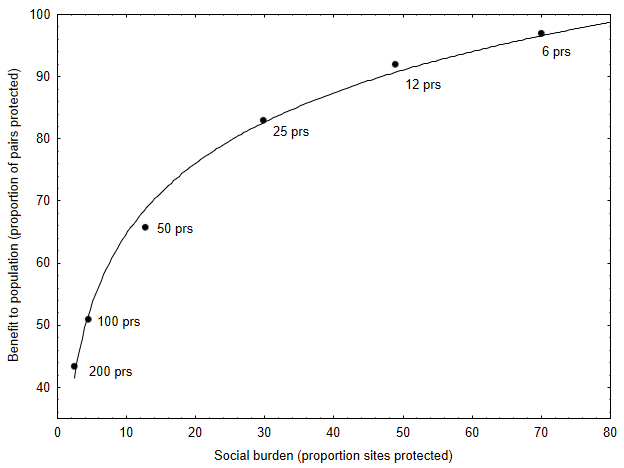
Relationship between social burden and species benefit for great blue herons in the Chesapeake Bay. The relationship suggests that the greatest benefit to cost ratio may lie between colony sizes of 25 and 50 pairs.