Eagles and Catfish in the Chesapeake Bay
January 15, 2026
Dr. Mitchell A. Byrd (1928-2026)
April 16, 2026FOR IMMEDIATE RELEASE
8 April 2026
Contact:
Bryan D. Watts, PhD (757) 221-2247
bdwatt@wm.edu
Statement on the Death of Mitchell A. Byrd
By The Center for Conservation Biology, William & Mary
The Center for Conservation Biology mourns the passing of our friend, teacher, scholar, conservation biologist, inspiration and role model Dr. Mitchell Agee Byrd. Dr. Byrd passed away on March 31 2026. He was 97 years old. Considered by many to be the father of nongame conservation in Virginia, Dr. Byrd was a modest man who was known widely for his work throughout Virginia and the Chesapeake Bay region with threatened and endangered birds including the bald eagle, peregrine falcon, osprey, red-cockaded woodpecker and piping plover.
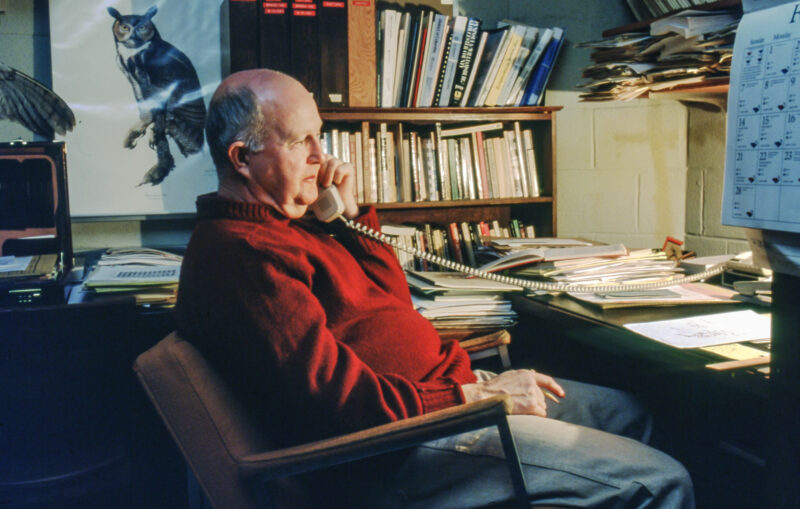
Dr. Mitchell Byrd in his Millington Hall office surrounded by bird books and working the phone. Photo by Lynda Richardson.
Known by many as “The Byrd Man”, Dr. Byrd was equally at home in the field working with birds, in the classroom lecturing to undergraduates or in the board room advocating for land protection. He became one of the most trusted voices for conservation of his generation and for decades maintained a relentless schedule to move conservation forward. He believed that an informed public was one of the keys to conservation success. For decades he averaged 15 public presentations and 25 media stories per year. Over time he came to recognize that land was the foundation of species protection and in the second half of his life he worked to establish wildlife refuges, state parks, state natural areas, wildlife management areas and private conservation lands. His passion and drive on behalf of wildlife and wild places inspired generations of biologists who have gone on to make a difference for species throughout the world.
Dr. Byrd enjoyed a long academic career and was affiliated with the College of William & Mary for 70 years. He was chair of the biology department for 13 years and both diversified the opportunities for students and doubled the faculty. He believed that the best measure of a department’s performance was the success of its students. The biology department has consistently been ranked in the top ten in the nation. His ornithology class was one of the most popular with students throughout the university. Beyond the classroom, Byrd published widely on conservation issues, served in many capacities within professional organizations, served on several federal teams to recover species, was one of the founders of the Waterbird Society (now a global professional society), and along with former student Bryan Watts co-founded The Center for Conservation Biology, a research unit focused on imperiled bird species throughout the Western Hemisphere. Dr. Byrd considered the success of his students to be his greatest academic achievement. He advised nearly 40 graduate students and thousands of undergraduates. Regardless of their chosen career path, he worked to provide students with opportunities and encouraged them to pursue their dreams. He was a cherished mentor.
Dr. Byrd received many honors and accolades for his conservation work. He was awarded more than 20 major conservation awards from a wide variety of agencies and organizations. He retired as Chancellor Professor Emeritus from William & Mary and has an endowed professorship named in his honor. Although the recognition was well deserved and much appreciated, he never focused on these things. Dr. Byrd was an engaged citizen who lived a life of service his entire life. He flew his last bald eagle survey when he was 91 and gave his last lecture on the endemic birds of the Caribbean Basin when he was 97. He had an incredible wit and was always ready with a joke. He was a true southern gentleman who cared deeply about people. He was a modest, soft-spoken man with a brand of chivalry that is sorely missing in today’s world. Dr. Byrd would regularly end interviews with the same sentiment. What separates humans from other organisms is our ability to observe, analyze and decide. This capacity imposes on us a corresponding duty to protect other species…” if you have the ability, you have the responsibility.”
About Dr. Mitchell Byrd
Mitchell Agee Byrd was born on 16 August, 1928 in Franklin, VA to Cyrus Oscar Byrd and Margaret Hill Byrd. He had an older sister, Mary Hill Byrd. His father worked for Camp Manufacturing, a major producer of paper products and the primary economic engine for the town. His mother would have a profound influence on Mitchell, encouraging him throughout his early years to reach his full potential. His family was not well off, certainly not well enough off to send a child to college. Mitchell was industrious. From the age of 12 he secured most of the distribution of newspapers coming from Norfolk to Franklin. He ran two paper routes in the morning and one in the afternoon. During the winters, he ran a trapline (taking mostly muskrats) to earn extra money. In the summers during his high school and undergraduate years he worked for Camp Manufacturing, mostly as a timber surveyor. He saved every dime he made. As he neared the end of high school, what seemed impossible in the beginning, was now a reality. He would attend college.
During all seasons in his early years, Mitchell spent his spare time on his boat out on the Blackwater River. Throughout his entire life, he could never tolerate being cooped up inside. At the age of 12 he was gifted a copy of T. Gilbert Pearson’s Birds of North America. The book had a profound influence on Mitchell, and it was one of the few early possessions that he kept throughout his life. Early on, Mitchell contemplated going to medical school. However, his growing love for the natural world along with his witness to the widespread timber cutting and habitat loss that was part of the paper industry around Franklin, would change his career goals. He wanted to be involved in habitat management and protection.
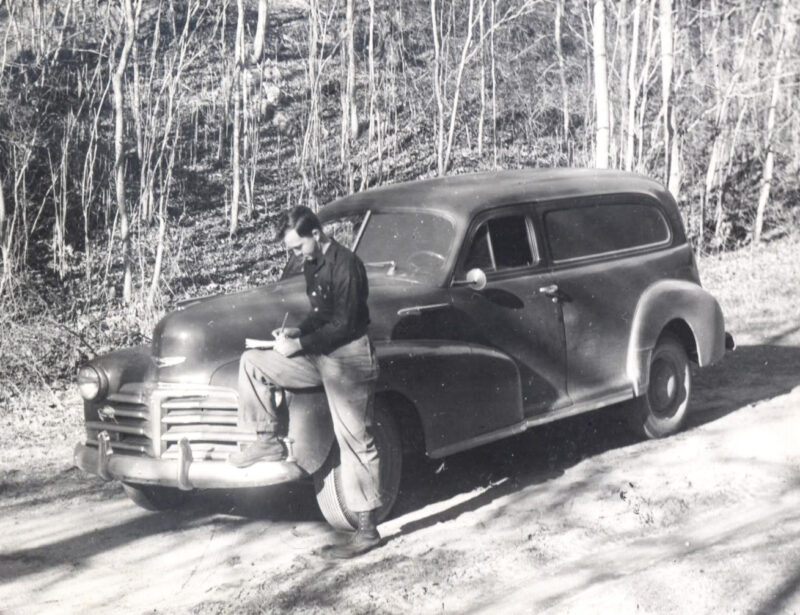
Mitchell Byrd in the field in Cumberland County collecting data for his doctoral dissertation. CCB photo.
Mitchell graduated from Franklin High School at the age of 16 and entered Virginia Polytechnic Institute and State University (VA Tech) as a cadet the month after his 17th birthday. He was able to afford the $40 per term and also support himself from the money he had squirreled away. As an undergraduate, he would conduct research on the relationship between bobwhite quail and land use on the university farms. He was inducted into the prestigious Phi Kappa Phi undergraduate honor society and later the biological honor society (Phi Sigma) and served as the president (1952-53) for the latter. He completed his undergraduate degree in Forestry and Wildlife Management in 1949. Following the completion of his undergraduate degree, Mitchell was awarded a teaching fellowship that paid $99/month and he stayed in Blacksburg for his master’s degree working with Professor Henry Mosby comparing the economic return from muskrat trapping between coastal marshes and inland streams. He completed his master’s degree in 1951. Mitchell’s doctoral work focused on changes in the early successional community (turkeys, rabbits, quail, songbirds) associated with abandoned farmland, a topic that was of major interest to wildlife management at the time. He conducted the work in Cumberland County under the direction of graduate advisor Professor Arthur Ballard Massey (Mitchell lived with the Massey family during much of his doctoral work). During this time, the large number of idle farm patches made Cumberland County, VA an ideal location for the study.
During his college years, Mitchell would meet and work with people that he would associate with throughout his life. Among others, he worked with Professor Henry Mosby (famed wild turkey ecologist and prominent figure in the development of wildlife management) who had a large impact on his career, Alexander “Sandy” Sprunt (Avian ecologist, National Audubon Society) and Charles O. Handley (Smithsonian Institution). Throughout his college years he worked extensively with the Virginia Department of Game and Inland Fisheries (now Virginia Department of Wildlife Resources). He would have a close relationship with the Department for the remainder of his life collaborating on many wildlife challenges. While conducting doctoral work in Cumberland County, the son of one of his primary contacts (Cell Newton) who was a forester for Cumberland State Forest, introduced Mitchell to Lois Ehrhardt who was a medical stenographer for the state health department. The two were married in 1954 and would be an inseparable team for more than 70 years. Lois worked as a stenographer within the W&M Student Health Services for nearly her entire career. She passed away on 22 October 2024.
Newly graduated and newly wed Dr. Byrd was inducted into the U.S. Army for a mandatory two years of service. He was assigned to Fort Gordon, GA for basic training. After training, the assignment officer told Mitchell they did not know what to do with him. The Scientific and Professional Personnel Act required that a trainee with a PhD be assigned to duty consistent with their academic training. He was eventually assigned to the Army’s Biological Warfare Center – Fort Detrick, MD. He waited six weeks to obtain his top-secret security clearance before being able to work in the lab. Biological warfare was not Mitchell’s favorite subject. Although he never spoke of the work, for decades he had symptoms that would send him home once or twice a year that he attributed to that period of his life. He always said that the people in the lab were top researchers and he learned a great deal from the experience. While stationed in Maryland, he took advantage of the Johns Hopkins and College Park libraries to continue his studies in wildlife management. After completing his service, Dr. Byrd was placed on inactive duty and was given a commission to the United States Public Health Service Reserve as a senior scientist. The commission is approximately equivalent to a Navy Commander – a commission that he held for many years.
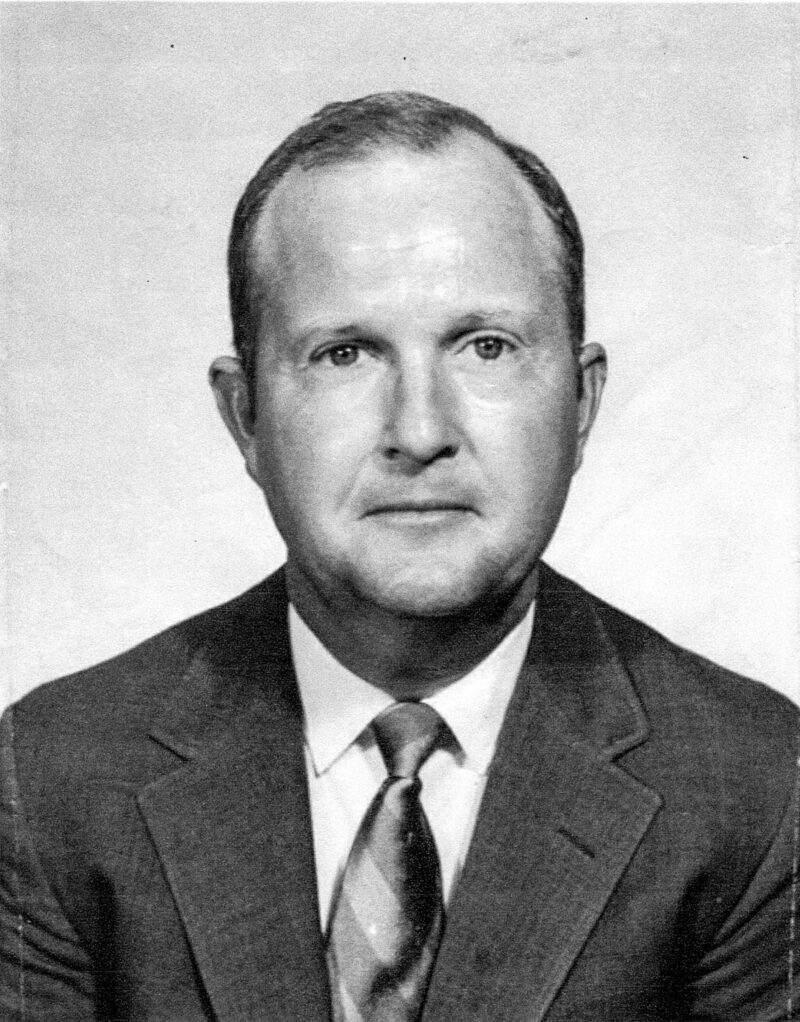
Early William & Mary portrait of Professor Mitchell Byrd. CCB photo.
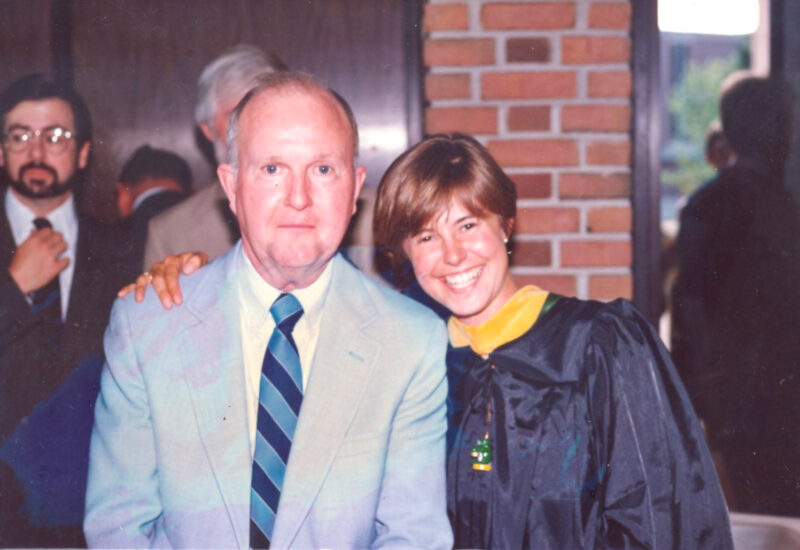
Dr. Byrd (lft) and undergraduate Vickie Finn during graduation celebration in Millington Hall. CCB photo.
Unemployed during the summer of 1956 with no prospects, Dr. Byrd was on a trip through Williamsburg when he stopped in for a visit with Professor John Baldwin the chair of the Biology Department at William & Mary. Baldwin had just been notified that one of the faculty members was leaving and so he hired Mitchell to start during the fall term. Dr. Byrd described the event as one of the most fortunate coincidences of his life and he would be grateful and committed to William & Mary for the next 70 years. In his first semester, the biology department was located in the basement of Washington Hall and had five faculty members. As an assistant professor, Mitchell’s salary was $4,200 per year. In the early years, he taught introductory biology, invertebrate zoology, anatomy, embryology and other courses as necessary. Dr. Byrd would be promoted to Associate Professor in 1959 and Full Professor in 1963.
Dr. Byrd would be chair (1962-1976) during the most transformative period in the history of the biology department. He would oversee an expansion of the faculty from 8 to 19 positions and a diversification of both the faculty and curriculum. He worked with President Paschall to secure the funds, design and build Millington Hall that would house the department for the next 40 years. He would write and receive a National Science Foundation grant to outfit the building with equipment including the construction of the iconic rooftop greenhouse. He would assemble an excellent group of teacher-scholars and bring the department to national prominence. During this period it would become the modern department that we know today.
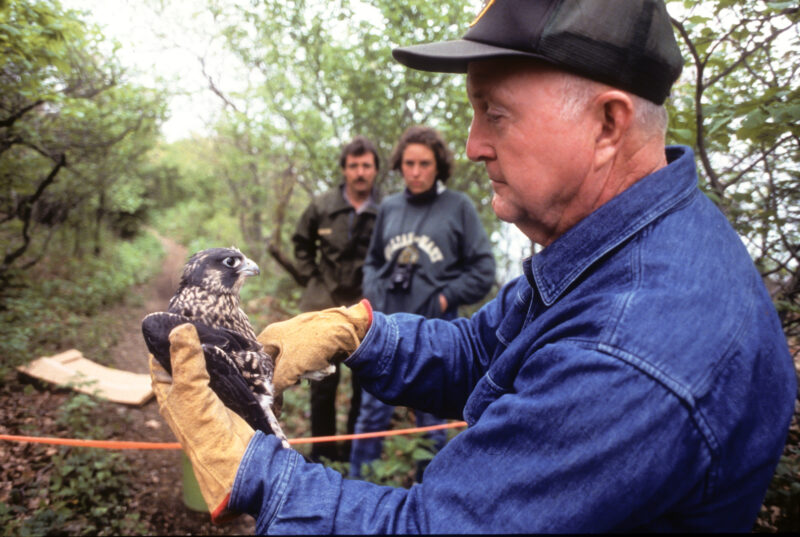
Dr. Byrd with young peregrine falcon in Shenandoah Park with W&M undergraduate Amanda Beheler and park biologist Keith Watson. Photo by Tim Wright.
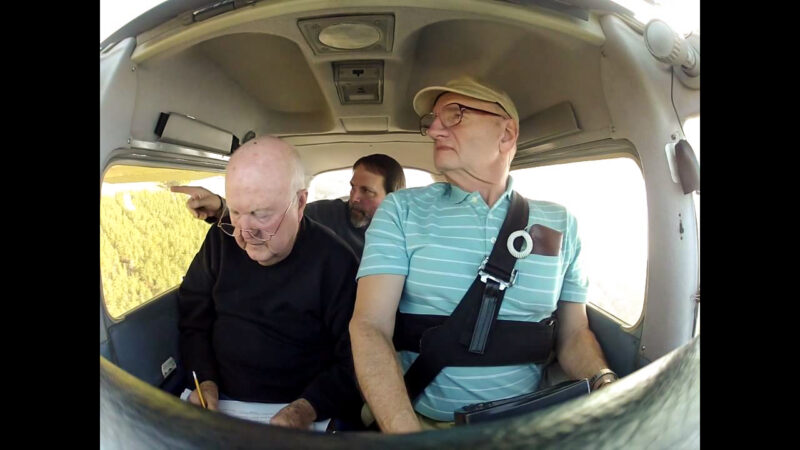
Dr. Byrd (lft) at 88 flying eagle surveys on the Rappahannock River with Bryan Watts and pilot Captain Fuzzzo Shermer. Dr. Byrd would continue flying the survey until he was 91 years old. Photo by Bryan Watts.
During the 25 years between 1970 and 1995, Dr. Byrd would have his most productive period. He was everywhere all the time, exhibiting tremendous energy and endurance. He advised 35 graduate students and worked on the thesis committee of scores more. Beyond his classroom responsibilities, he reveled in providing undergraduate students with their first field experience with birds. He would lead many students into the conservation field. He edited two chapters on threatened and endangered bird species in Virginia for symposium volumes. He organized national symposia on osprey and black bears. He hosted international scientific meetings and served on several committees for scientific associations. He served as president of the Virginia Society of Ornithology. He served on several boards for land-based conservation groups. Governor Robb appointed Dr. Byrd to the Caledon Task Force. Dr. Byrd and students collected extensive data on eagles in the area that resulted in the delineation and protection of the Caledon Natural Area. Negotiations with Maryland led to the only designated protected waters for nonbreeding eagles in the Chesapeake Bay. He was appointed to lead the U.S. Fish and Wildlife Service Chesapeake Bay Bald Eagle Recovery Team that produced an initial recovery plan and a revision. He was appointed to the U.S. Fish and Wildlife Service Eastern Peregrine Falcon Recovery Team. He flew the first heron survey in the mid-Atlantic region in 1975. He took over the bald eagle breeding survey in Virginia in 1977 and helped conduct the survey for 40 years. He managed the peregrine falcon reintroduction program in Virginia releasing 242 captive-reared falcons between 1978 and 1993 and recovering the population to pre-DDT levels. He monitored osprey throughout the lower Chesapeake Bay for 20 years. He conducted the first systematic survey for red-cockaded woodpeckers in southside Virginia and the first piping plover survey in coastal Virginia. In a welcomed twist of fate, he would negotiate an agreement with Camp Manufacturing to protect some pinelands for red-cockaded woodpeckers. He was appointed by the Governor to the board of the Virginia Museum of Natural History. Dr. Byrd fought against numerous contaminants proposed for use around the Chesapeake Bay including Carbofuran that was particularly lethal to birds. He testified and wrote against the approval of many land development projects that he felt were sited in sensitive areas. Dr. Byrd gave hundreds of presentations to scientific organizations, agencies and citizen groups throughout the region. He set up a fund within William & Mary and placed honorariums received for talks to support conservation and student projects.
Dr. Byrd was involved in most major land protection projects for more than 50 years. His efforts led to the establishment of the James River National Wildlife Refuge to protect bald eagle habitat. He was involved in supporting the establishment of Mason Neck National Wildlife Refuge, Rappahannock River National Wildlife Refuge and Eastern Shore of Virginia National Wildlife Refuge. He supported the establishment of many state parks and natural areas including Caledon and Kiptopeke State Park, a very significant area for migrant birds. He served on The Nature Conservancy board for 12 years advocating for the protection of critical wildlife lands. He served on the board of the James River Association and worked with the Isaak Walton League and the Virginia Outdoors Foundation to protect natural areas.
Dr. Byrd’s work and leadership in conservation were acknowledged widely. He received numerous awards and honors including the Presidential Conservation Award (Virginia Wildlife Federation), Wildlife Conservationist of the Year (Virginia Wildlife Federation), National Conservation Award (Daughters of the American Revolution), Conservationist of the Year (Governor’s Award), Chesapeake Bay Conservation Award (Isaak Walton League), Lifetime Service Award (The Nature Conservancy), Recovery Champion Award (U.S. Fish and Wildlife Service) and many others. The Virginia Society of Ornithology named their conservation award in his honor. William & Mary installed and dedicated a large sculpture titled “Soaring Eagles” done by former student David Turner in the Sadler Center. In October of 2025, The Nature Conservancy named a walking trail for Dr. Byrd within the Piney Grove Preserve (nucleus of red-cockaded woodpecker recovery).
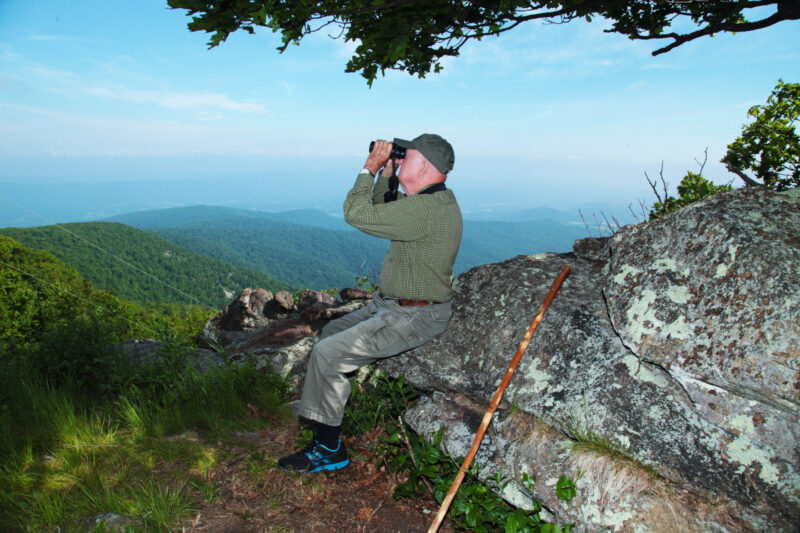
Dr. Byrd where he wanted to be in later years watching young peregrine falcons swirl over Hogback Mountain in Shenandoah National Park. Photo by Bryan Watts.
Dr. Byrd retired from the biology department in the summer of 1993. In retirement, he continued to work nearly daily with The Center for Conservation Biology for a decade. After this period, he continued to conduct fieldwork on several projects and was engaged with the ongoing conservation work of The Center and beyond for another 20 years. For more than 40 years during his working life, Mitchell and Lois were never able to travel during the spring and early summer months due to his academic commitments and fieldwork. In most years, they took trips in late July and August between the summer field season and the beginning of classes. After retirement, Mitchell began to take spring trips to the mountains to enjoy spring migration as he had done as a student in Blacksburg. In later years he was able to travel to every state, most of Canada, Africa, Australia and New Zealand, Europe and much of Latin America to see many bird species that he had taught about for decades In his last years, Dr. Byrd enjoyed getting out to birdwatch in many favorite places around the Chesapeake Bay.
Dr. Byrd died early in the morning on 31 March 2026. He lived a full life of integrity and service. He made the world a better place for birds and people.