Eagles and Catfish in the Chesapeake Bay
Peregrine Clutches
January 15, 2026By: Bryan Watts
1/9/26
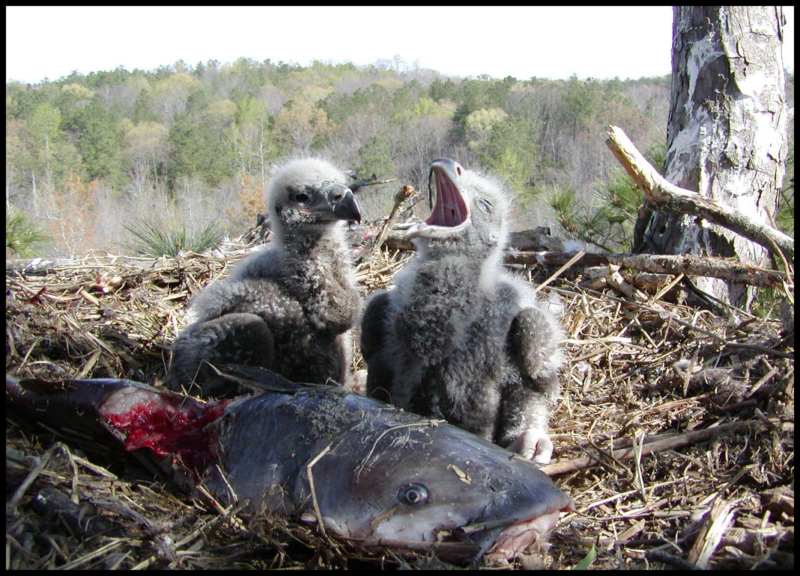
In a study of diet and provisioning of broods by bald eagles in the lower Chesapeake Bay in the early 2000s, Catherine Markham showed that more than 90% of prey provided to broods was fish and that catfish were the dominant fish group. Catfish appear to be an important fish group for eagles within the region, but the species composition has shifted over time. Eagles use five species of catfish within the Bay including three large species (blue catfish, channel catfish, white catfish) and two small species (brown bullhead, yellow bullhead).
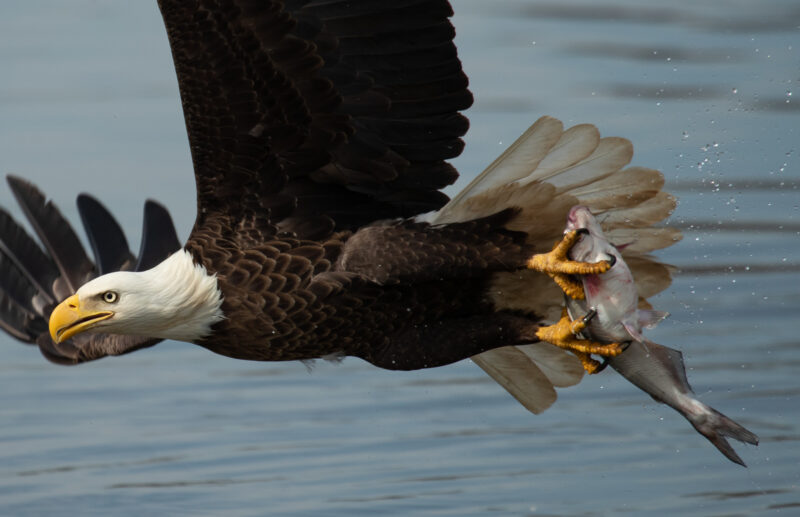
Of the large catfish species, the white catfish is native within the Chesapeake while both the blue and channel catfish are introduced and invasive. White catfish are native to Atlantic coastal rivers from the Hudson south to Florida. Channel catfish are native to the Mississippi Valley, Gulf Coast and Peninsular Florida. This species was introduced to Atlantic Coast rivers including the Chesapeake Bay in the early 1900s for sport fishing. Blue catfish are native to the Mississippi valley and a few other Gulf tributaries and west to the Platte River. Blue catfish were introduced in the James and Rappahannock rivers in the late 1960s and early 1970s for sport fishing. An aggressive invasive species, blue catfish have spread throughout much of the tidal fresh and brackish reaches of the Chesapeake Bay and consume many of the native fish.

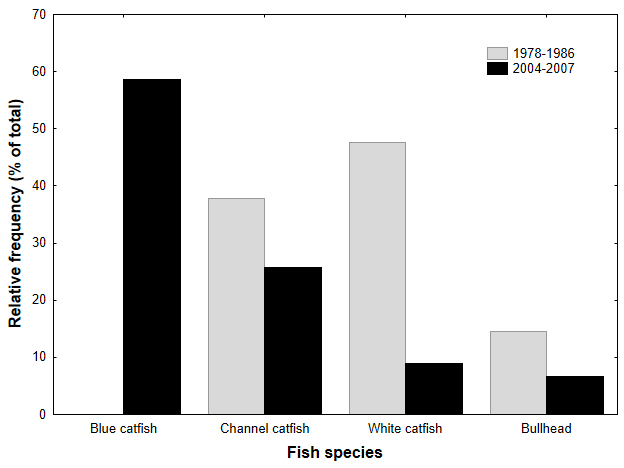
The use of native vs invasive catfish by bald eagles has changed over time. Between 1978 and 1986, the National Wildlife Federation’s Raptor Information Center supported a banding crew that attempted to band all eaglets produced in the Chesapeake Bay region. In addition to banding young the team recorded prey found in nests. During this period the native white catfish was the dominant catfish species found representing 47.6% and bullheads accounted for 14.6%. The majority (62.2%) of catfish used were native. Channel catfish accounted for 37.8% and no blue catfish were recorded.
Between 2004 and 2007 I visited many eagle nests in the fall after the breeding season and collected more than 500 catfish spines. The spines were identified by Amanda Duvall who was a graduate student working with Michael Fines in the Virginia Commonwealth University Biology Department. Amanda worked on a thesis developing techniques for identifying catfish spines in the Chesapeake Bay. The species composition within the later sample was strikingly different than the earlier sample. Blue and channel catfish accounted for 58.6% and 25.7% of all samples collected. White catfish and bullheads accounted for 9.0% and 6.7%, respectively. Introduced invasive catfish now account for 84.3% of catfish used. In a very short period of time, invasive catfish have increased in importance as fish used to provision broods from 37.8% to 84.3%. The introduction of these invasives into the Chesapeake Bay ecosystem is having an ongoing impact on the native fish community. Ever the adaptable predator, bald eagles are adapting to the new menu.