
Dr. Mitchell A. Byrd (1928-2026)
April 16, 2026
Chasing Wayne’s Warblers Through the Great Dismal Swamp
April 17, 2026By: Bryan Watts
4/1/2026
It is that time of year again when great egrets are returning to their nesting colonies, beginning ritualized courtship displays, collecting sticks, building nests and bickering with their neighbors. Soon, females will lay eggs and the pairs will settle into the long nesting season with all of its day-to-day challenges. In addition to the hurdles that all egret pairs face during the breeding season, urban egrets face an ongoing conflict with human neighbors and churning of sites.
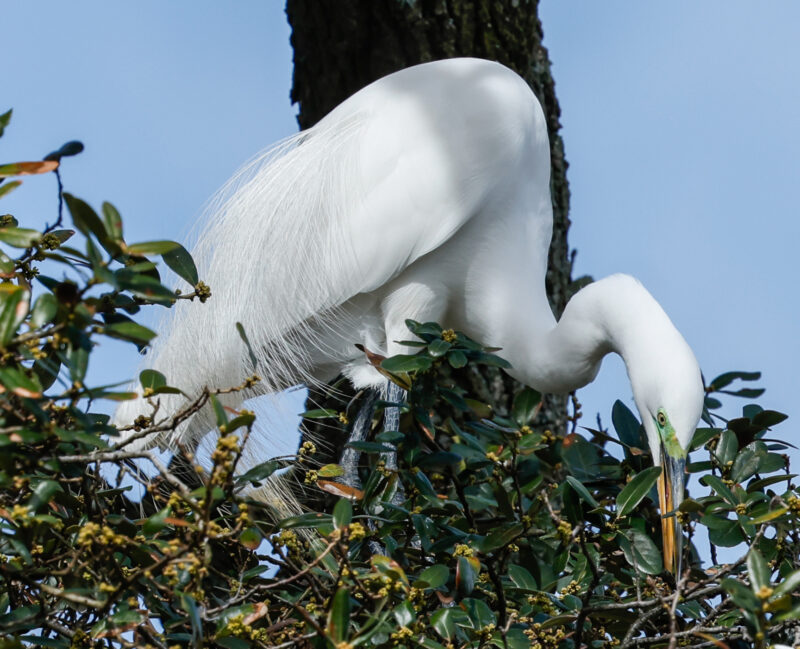
Egret collecting sticks from a live oak to make nest. Egrets nests are not very substantial and so must be rebuilt each year. Photo by Bryan Watts.
During the spring of 1986, Bryan Watts and Dana Bradshaw began surveying for and monitoring great egret colonies within the urban cities (Norfolk, Virginia Beach, Chesapeake, Portsmouth, Hampton, Newport News) of Tidewater Virginia. They would go out weekly during the early nesting season to document colonies and monitor the arrival of pairs. Very early in the effort the conflict between egrets and homeowners was clear.
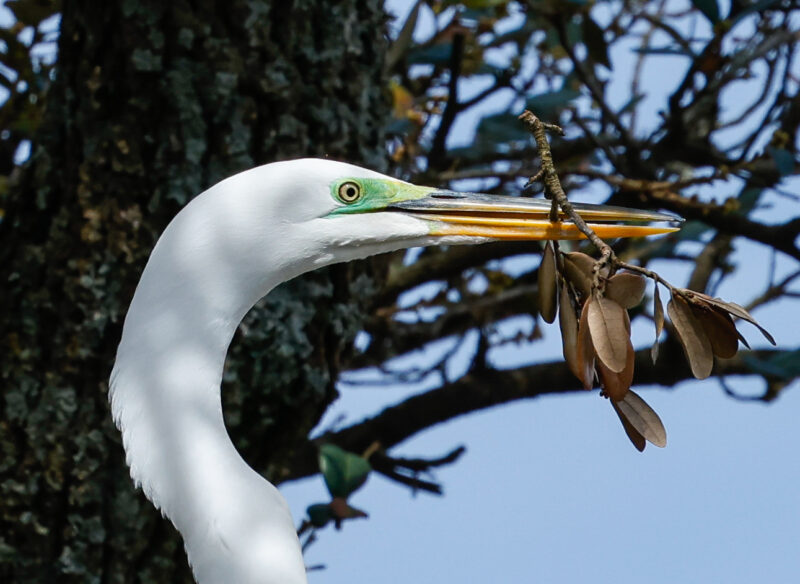
Egret with stick to be used in nest construction. Photo by Bryan Watts.
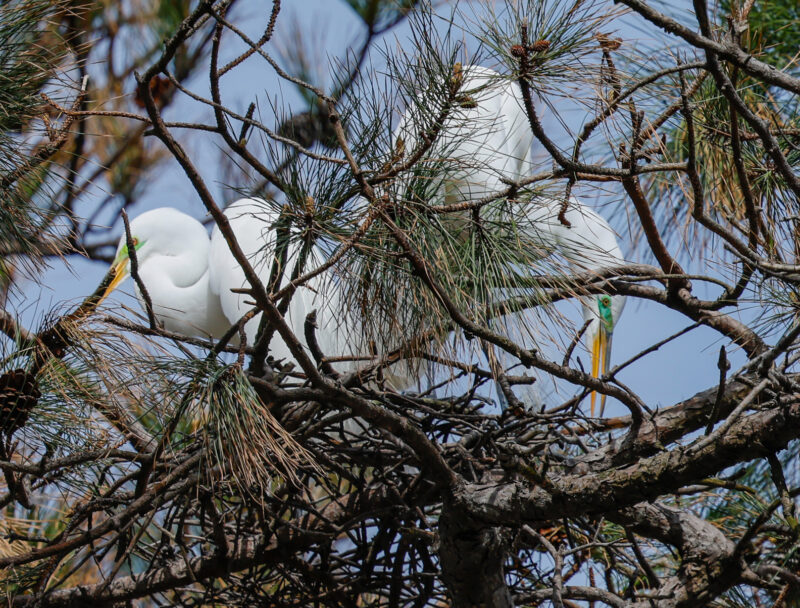
Pair of egrets working on nest. Photo by Bryan Watts.
The concentration of often 300+ pairs in a small area stretches the limits of tolerance for many of the residents living below. The sounds of several hundred young egrets calling day and night, the shower of guano that kills lawns and shrubs and the litter of dead young and fish on the ground becomes more than most homeowners are willing to endure. The consistent outcry from residents has been “why don’t these birds go somewhere else”.
Over the past 40 years, a consistent sequence of events has emerged. Most colonies existed on vacant lots with old pines where they were stable over long periods of time. Owners of the vacant lots either tolerated the colonies or were happy to have them. When the owners died their heirs sold the properties. In some cases, the heirs moved the birds off the property before selling and in others they sold the property with the colony intact. Either way, the generational change set off a consistent chain of events. The colony would settle in the next year in one of the closest stands of old pines. Stands were invariably over existing homes. Residents would ban together and ping pong the birds around the area until the birds moved on. Colonies moved as many as four times before abandoning the area entirely.
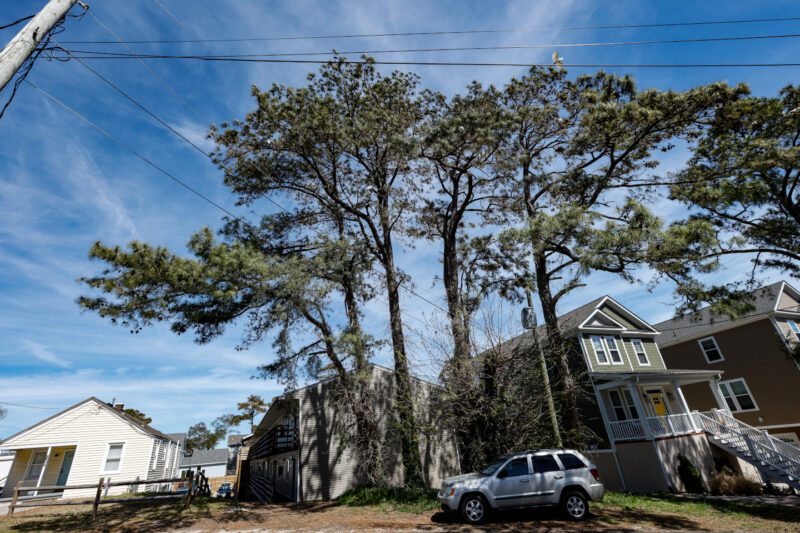
Remnant egret colony after 90% of trees have been cut down to accommodate development. Pairs will pile into remaining trees likely resulting in residents to revolt and either take remaining trees down or move the birds using pyrotechnics. The birds will likely move to another close stand of trees to start the process again. Photo by Bryan Watts.
Some of the initial colony locations were used for 50 years or more and often were present before the residential areas were developed. By the time the vacant lots were sold there were no more suitable lots to occupy. The result is that egrets have been systematically eliminated from several tributaries within the region. Of 17 colonies monitored over time, only 4 are still occupied and half of those have had large sections of pines removed to accommodate house construction.
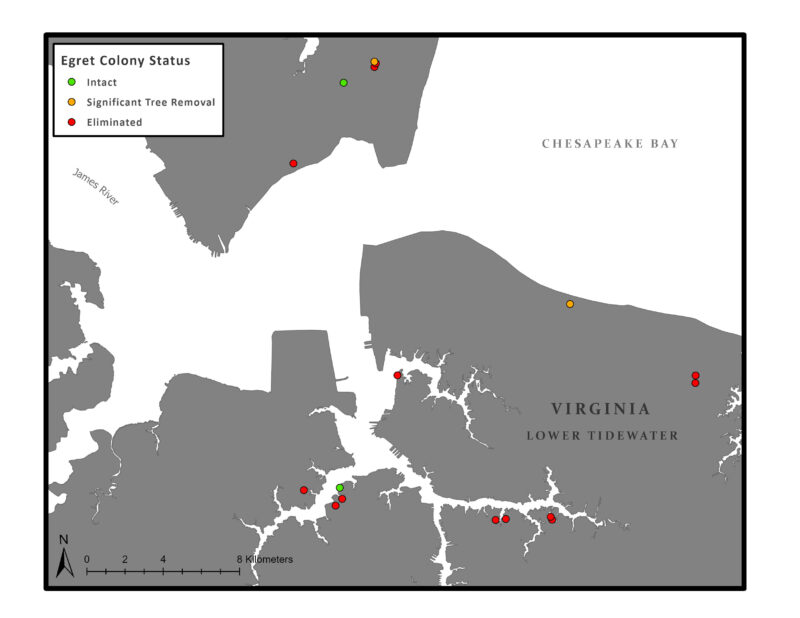
Map of colony sites (1986-2026) and their current state within Tidewater Virginia. 75% of documented colony sites have been dispersed.
The answer to the common question, “Why don’t these birds go somewhere else?” is that they will eventually move beyond the urban footprint. The cost is that they are no longer a part of the ecosystem that supported them for generations. Human development within these urban areas has become so dense and so complete that there is no longer room for egrets and many other species.